Loading...
Searching...
No Matches
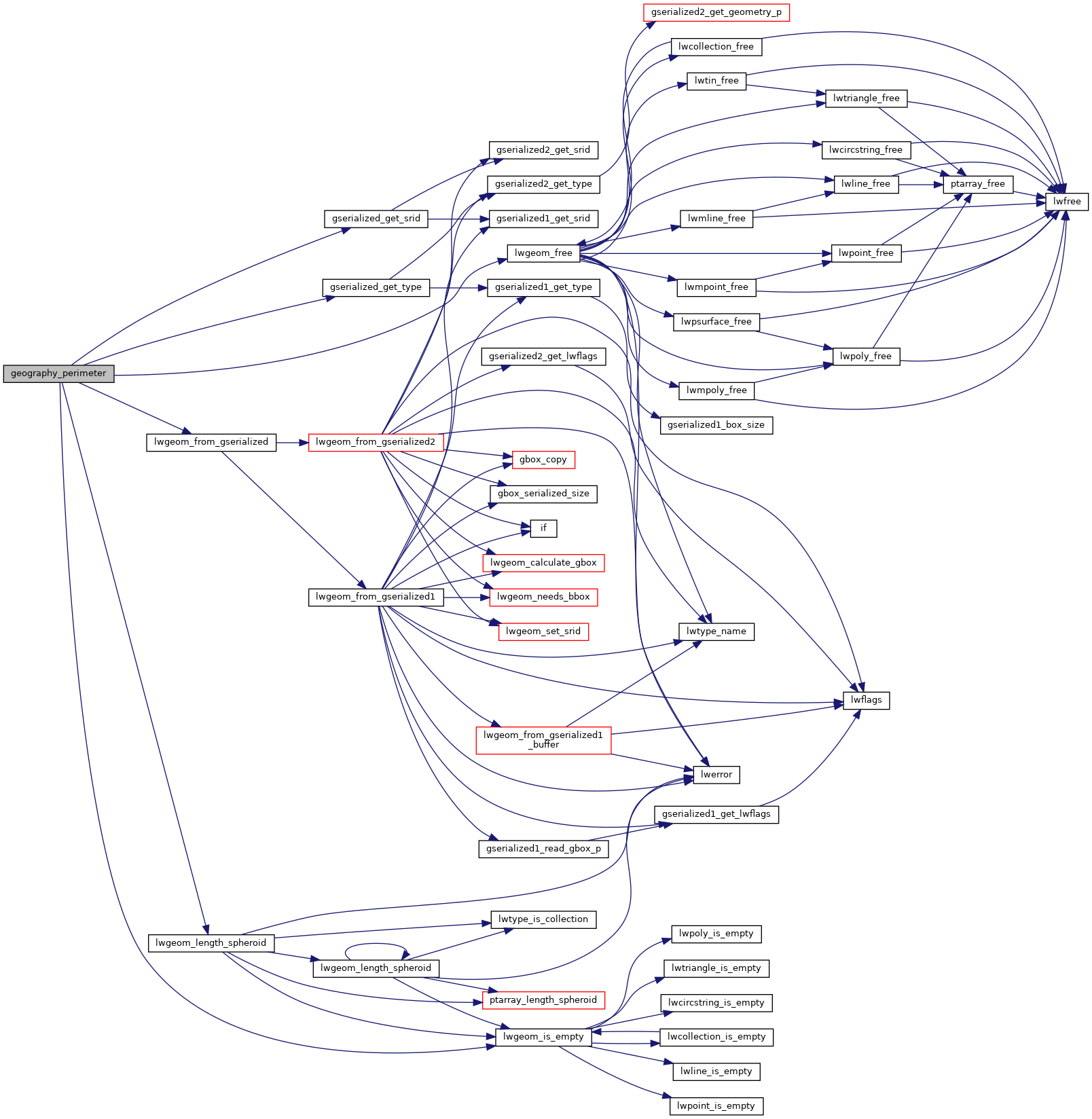
◆ geography_perimeter()
| Datum geography_perimeter | ( | PG_FUNCTION_ARGS | ) |
Definition at line 575 of file geography_measurement.c.
576{
577 LWGEOM *lwgeom = NULL;
578 GSERIALIZED *g = NULL;
579 double length;
583
584 /* Get our geometry object loaded into memory. */
585 g = PG_GETARG_GSERIALIZED_P(0);
586
587 /* Only return for area features. */
590 {
591 PG_RETURN_FLOAT8(0.0);
592 }
593
594 lwgeom = lwgeom_from_gserialized(g);
595
596 /* EMPTY things have no perimeter */
598 {
599 lwgeom_free(lwgeom);
600 PG_RETURN_FLOAT8(0.0);
601 }
602
603 /* Read our calculation type */
604 use_spheroid = PG_GETARG_BOOL(1);
605
606 /* Initialize spheroid */
608
609 /* User requests spherical calculation, turn our spheroid into a sphere */
610 if ( ! use_spheroid )
612
613 /* Calculate the length */
615
616 /* Something went wrong... */
617 if ( length < 0.0 )
618 {
619 elog(ERROR, "lwgeom_length_spheroid returned length < 0.0");
620 PG_RETURN_NULL();
621 }
622
623 /* Clean up, but not all the way to the point arrays */
624 lwgeom_free(lwgeom);
625
626 PG_FREE_IF_COPY(g, 0);
627 PG_RETURN_FLOAT8(length);
628}
int32_t gserialized_get_srid(const GSERIALIZED *g)
Extract the SRID from the serialized form (it is packed into three bytes so this is a handy function)...
Definition gserialized.c:126
LWGEOM * lwgeom_from_gserialized(const GSERIALIZED *g)
Allocate a new LWGEOM from a GSERIALIZED.
Definition gserialized.c:239
uint32_t gserialized_get_type(const GSERIALIZED *g)
Extract the geometry type from the serialized form (it hides in the anonymous data area,...
Definition gserialized.c:89
double lwgeom_length_spheroid(const LWGEOM *geom, const SPHEROID *s)
Calculate the geodetic length of a lwgeom on the unit sphere.
Definition lwgeodetic.c:3297
static int lwgeom_is_empty(const LWGEOM *geom)
Return true or false depending on whether a geometry is an "empty" geometry (no vertices members)
Definition lwinline.h:193
Definition liblwgeom.h:429
Definition liblwgeom.h:443
Definition liblwgeom.h:360
References COLLECTIONTYPE, gserialized_get_srid(), gserialized_get_type(), LW_TRUE, lwgeom_free(), lwgeom_from_gserialized(), lwgeom_is_empty(), lwgeom_length_spheroid(), MULTIPOLYGONTYPE, POLYGONTYPE, and s.
Here is the call graph for this function: