Loading...
Searching...
No Matches
◆ union_dbscan_general()
|
static |
Definition at line 390 of file lwgeom_geos_cluster.c.
391{
392 uint32_t p, i;
395 {
396 .items_found = NULL,
397 .num_items_found = 0,
398 .items_found_size = 0
399 };
401 uint32_t* neighbors;
402 char* in_a_cluster;
403 char* is_in_core;
404
406 memset(in_a_cluster, 0, num_geoms * sizeof(char));
407
408 if (in_a_cluster_ret)
409 *in_a_cluster_ret = in_a_cluster;
410
411 /* Bail if we don't even have enough inputs to make a cluster. */
412 if (num_geoms < min_points)
413 {
414 if (!in_a_cluster_ret)
415 lwfree(in_a_cluster);
417 }
418
420 if (tree.tree == NULL)
421 {
422 destroy_strtree(&tree);
424 }
425
427 memset(is_in_core, 0, num_geoms * sizeof(char));
429
430 for (p = 0; p < num_geoms; p++)
431 {
432 uint32_t num_neighbors = 0;
433 int rv;
434
436 continue;
437
438 rv = dbscan_update_context(tree.tree, &cxt, geoms, p, eps);
440 {
441 destroy_strtree(&tree);
443 }
444
445 /* We didn't find enough points to do anything, even if they are all within eps. */
447 continue;
448
450 {
451 uint32_t q = *((uint32_t*) cxt.items_found[i]);
452
453 if (num_neighbors >= min_points)
454 {
455 /* If we've already identified p as a core point, and it's already
456 * in the same cluster in q, then there's nothing to learn by
457 * computing the distance.
458 */
460 continue;
461
462 /* Similarly, if q is already identified as a border point of another
463 * cluster, there's no point figuring out what the distance is.
464 */
465 if (in_a_cluster[q] && !is_in_core[q])
466 continue;
467 }
468
470 if (mindist == FLT_MAX)
471 {
472 success = LW_FAILURE;
473 break;
474 }
475
476 if (mindist <= eps)
477 {
478 /* If we haven't hit min_points yet, we don't know if we can union p and q.
479 * Just set q aside for now.
480 */
481 if (num_neighbors < min_points)
482 {
483 neighbors[num_neighbors++] = q;
484
485 /* If we just hit min_points, we can now union all of the neighbor geometries
486 * we've been saving.
487 */
488 if (num_neighbors == min_points)
489 {
490 uint32_t j;
491 is_in_core[p] = LW_TRUE;
492 in_a_cluster[p] = LW_TRUE;
493 for (j = 0; j < num_neighbors; j++)
494 {
495 union_if_available(uf, p, neighbors[j], is_in_core, in_a_cluster);
496 }
497 }
498 }
499 else
500 {
501 /* If we're above min_points, no need to store our neighbors, just go ahead
502 * and union them now. This may allow us to cut out some distance
503 * computations.
504 */
505 union_if_available(uf, p, q, is_in_core, in_a_cluster);
506 }
507 }
508 }
509
510 if (!success)
511 break;
512 }
513
514 lwfree(neighbors);
515 lwfree(is_in_core);
516
517 /* Free in_a_cluster if we're not giving it to our caller */
518 if (!in_a_cluster_ret)
519 lwfree(in_a_cluster);
520
523
524 destroy_strtree(&tree);
525 return success;
526}
double lwgeom_mindistance2d_tolerance(const LWGEOM *lw1, const LWGEOM *lw2, double tolerance)
Function handling min distance calculations and dwithin calculations.
Definition measures.c:222
static int dbscan_update_context(GEOSSTRtree *tree, struct QueryContext *cxt, LWGEOM **geoms, uint32_t p, double eps)
Definition lwgeom_geos_cluster.c:263
static struct STRTree make_strtree(void **geoms, uint32_t num_geoms, char is_lwgeom)
Make a GEOSSTRtree that stores a pointer to a variable containing the array index of the input geoms.
Definition lwgeom_geos_cluster.c:80
static void destroy_strtree(struct STRTree *tree)
Clean up STRTree after use.
Definition lwgeom_geos_cluster.c:122
static void union_if_available(UNIONFIND *uf, uint32_t p, uint32_t q, char *is_in_core, char *in_a_cluster)
Definition lwgeom_geos_cluster.c:294
static int lwgeom_is_empty(const LWGEOM *geom)
Return true or false depending on whether a geometry is an "empty" geometry (no vertices members)
Definition lwinline.h:199
Definition lwgeom_geos_cluster.c:36
Definition lwgeom_geos_cluster.c:44
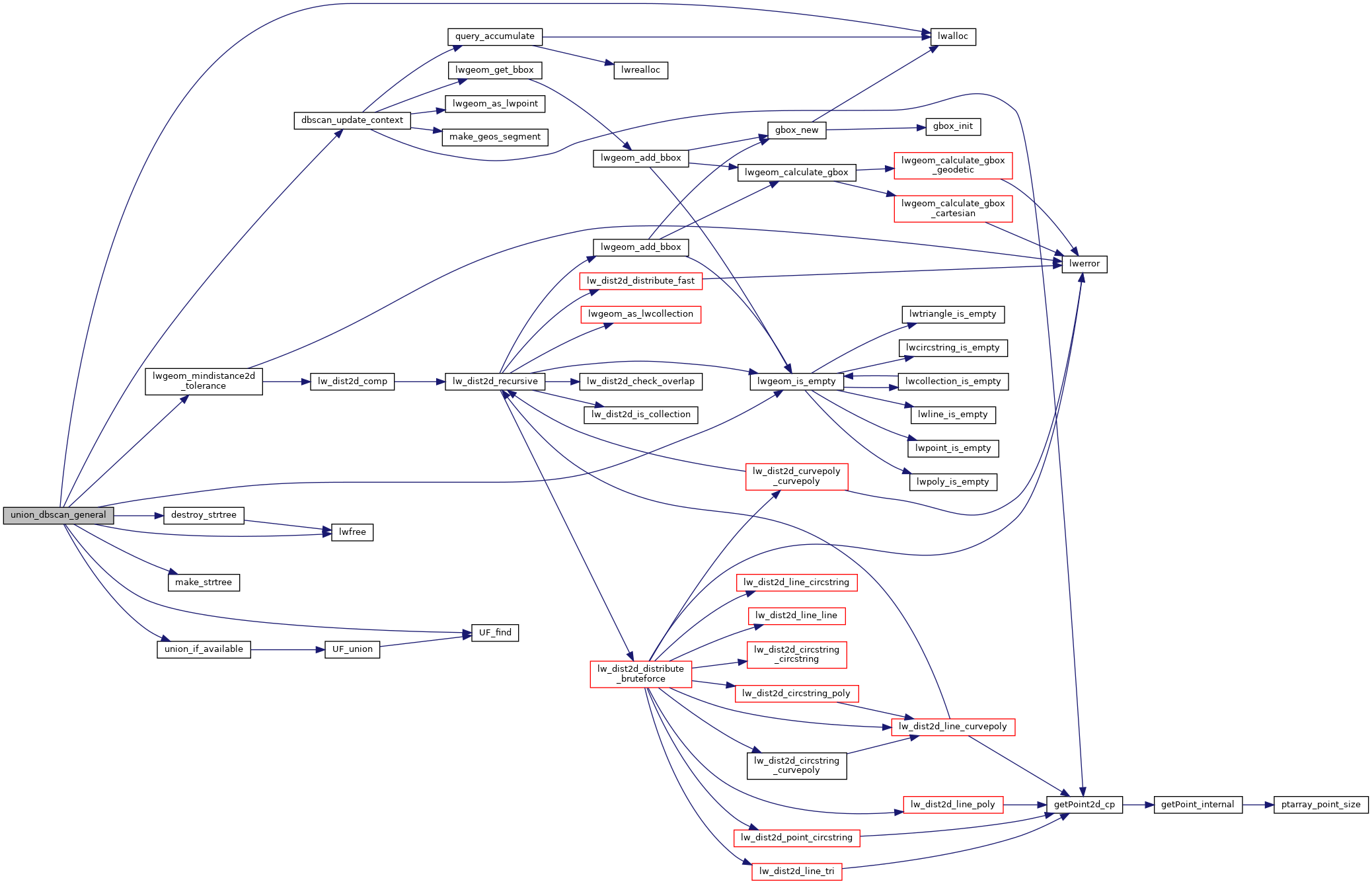
References dbscan_update_context(), destroy_strtree(), QueryContext::items_found, LW_FAILURE, LW_SUCCESS, LW_TRUE, lwalloc(), lwfree(), lwgeom_is_empty(), lwgeom_mindistance2d_tolerance(), make_strtree(), QueryContext::num_items_found, STRTree::tree, UF_find(), and union_if_available().
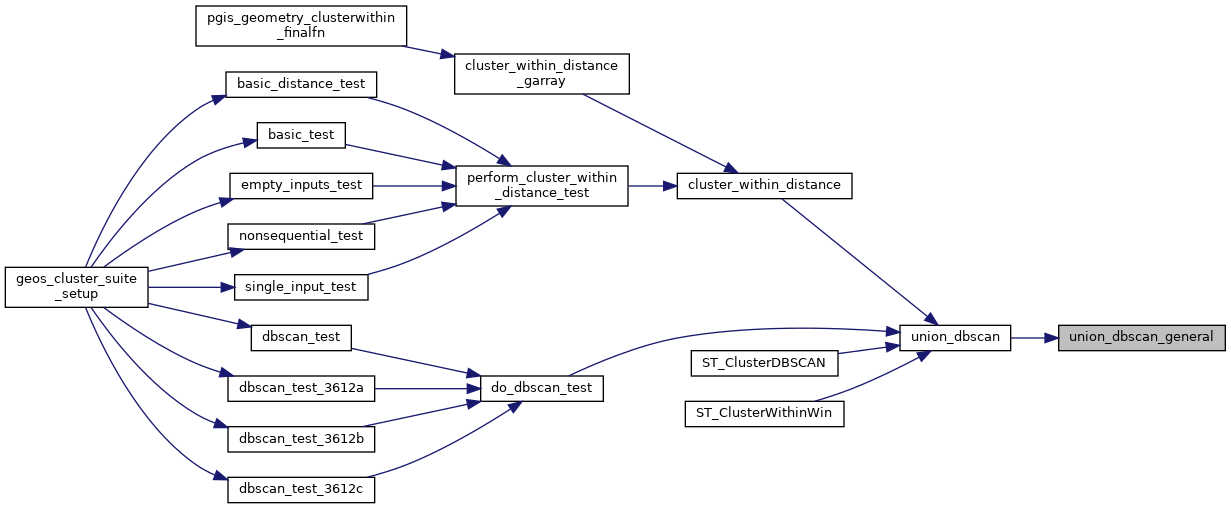
Referenced by union_dbscan().
Here is the call graph for this function:
Here is the caller graph for this function: