Loading...
Searching...
No Matches
lwin_twkb.c File Reference
Include dependency graph for lwin_twkb.c:
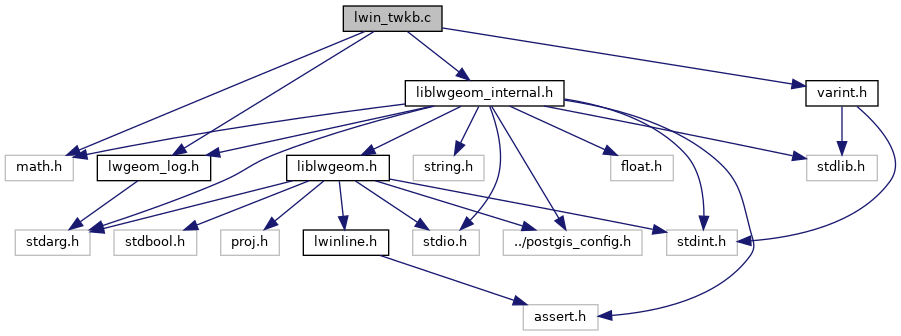
Go to the source code of this file.
Data Structures | |
| struct | twkb_parse_state |
| Used for passing the parse state between the parsing functions. More... | |
Macros | |
| #define | TWKB_IN_MAXCOORDS 4 |
Functions | |
| LWGEOM * | lwgeom_from_twkb_state (twkb_parse_state *s) |
| Internal function declarations. | |
| static void | twkb_parse_state_advance (twkb_parse_state *s, size_t next) |
| Check that we are not about to read off the end of the WKB array. | |
| static int64_t | twkb_parse_state_varint (twkb_parse_state *s) |
| static uint64_t | twkb_parse_state_uvarint (twkb_parse_state *s) |
| static double | twkb_parse_state_double (twkb_parse_state *s, double factor) |
| static void | twkb_parse_state_varint_skip (twkb_parse_state *s) |
| static uint32_t | lwtype_from_twkb_type (uint8_t twkb_type) |
| static uint8_t | byte_from_twkb_state (twkb_parse_state *s) |
| Byte Read a byte and advance the parse state forward. | |
| static POINTARRAY * | ptarray_from_twkb_state (twkb_parse_state *s, uint32_t npoints) |
| POINTARRAY Read a dynamically sized point array and advance the parse state forward. | |
| static LWPOINT * | lwpoint_from_twkb_state (twkb_parse_state *s) |
| POINT. | |
| static LWLINE * | lwline_from_twkb_state (twkb_parse_state *s) |
| LINESTRING. | |
| static LWPOLY * | lwpoly_from_twkb_state (twkb_parse_state *s) |
| POLYGON. | |
| static LWCOLLECTION * | lwmultipoint_from_twkb_state (twkb_parse_state *s) |
| MULTIPOINT. | |
| static LWCOLLECTION * | lwmultiline_from_twkb_state (twkb_parse_state *s) |
| MULTILINESTRING. | |
| static LWCOLLECTION * | lwmultipoly_from_twkb_state (twkb_parse_state *s) |
| MULTIPOLYGON. | |
| static LWCOLLECTION * | lwcollection_from_twkb_state (twkb_parse_state *s) |
| COLLECTION, MULTIPOINTTYPE, MULTILINETYPE, MULTIPOLYGONTYPE. | |
| static void | header_from_twkb_state (twkb_parse_state *s) |
| LWGEOM * | lwgeom_from_twkb (const uint8_t *twkb, size_t twkb_size, char check) |
| WKB inputs must have a declared size, to prevent malformed WKB from reading off the end of the memory segment (this stops a malevolent user from declaring a one-ring polygon to have 10 rings, causing the WKB reader to walk off the end of the memory). | |