PostGIS 3.7.0dev-r@@SVN_REVISION@@
Loading...
Searching...
No Matches

◆ ShpDumperOpenTable()

int ShpDumperOpenTable ( SHPDUMPERSTATE state)

Definition at line 1313 of file pgsql2shp-core.c.

1314{
1315 PGresult *res;
1316
1317 char buf[256];
1318 int gidfound = 0, i, j, ret, status;
1319 stringbuffer_t sb;
1320 char *quoted = NULL;
1321
1322 /* Open the column map if one was specified */
1323 if (state->config->column_map_filename)
1324 {
1326 &state->column_map, state->message, SHPDUMPERMSGLEN);
1327 if (!ret) return SHPDUMPERERR;
1328 }
1329
1330 /* If a user-defined query has been specified, create and point the state to our new table */
1331 if (state->config->usrquery)
1332 {
1333 state->table = core_asprintf("__pgsql2shp%lu_tmp_table", (long)getpid());
1334 stringbuffer_init(&sb);
1336 "CREATE TEMP TABLE \"%s\" AS %s",
1337 state->table, state->config->usrquery);
1338 res = PQexec(state->conn, stringbuffer_getstring(&sb));
1340
1341 /* Execute the code to create the table */
1342 if (PQresultStatus(res) != PGRES_COMMAND_OK)
1343 {
1344 snprintf(state->message, SHPDUMPERMSGLEN, _("Error executing user query: %s"), PQresultErrorMessage(res));
1345 PQclear(res);
1346 return SHPDUMPERERR;
1347 }
1348 PQclear(res);
1349 }
1350 else
1351 {
1352 /* Simply point the state to copies of the supplied schema and table */
1353 state->table = strdup(state->config->table);
1354 if (state->config->schema)
1355 state->schema = strdup(state->config->schema);
1356 }
1357
1358 stringbuffer_init(&sb);
1359 /* Get the list of columns and their types for the selected table */
1360 if (state->schema)
1361 {
1363 "SELECT a.attname, a.atttypid, "
1364 "a.atttypmod, a.attlen FROM "
1365 "pg_attribute a, pg_class c, pg_namespace n WHERE "
1366 "n.nspname = '%s' AND a.attrelid = c.oid AND "
1367 "n.oid = c.relnamespace AND "
1368 "a.atttypid != 0 AND "
1369 "a.attnum > 0 AND c.relname = '%s'",
1370 state->schema,
1371 state->table);
1372 }
1373 else
1374 {
1376 "SELECT a.attname, a.atttypid, "
1377 "a.atttypmod, a.attlen FROM "
1378 "pg_attribute a, pg_class c WHERE "
1379 "a.attrelid = c.oid and a.attnum > 0 AND "
1380 "a.atttypid != 0 AND "
1381 "c.relname = '%s' AND "
1382 "pg_catalog.pg_table_is_visible(c.oid)",
1383 state->table);
1384 }
1385
1386 LWDEBUGF(3, "query is: %s\n", stringbuffer_getstring(&sb));
1387
1388 res = PQexec(state->conn, stringbuffer_getstring(&sb));
1390
1391 if (PQresultStatus(res) != PGRES_TUPLES_OK)
1392 {
1393 snprintf(state->message, SHPDUMPERMSGLEN, _("Error querying for attributes: %s"), PQresultErrorMessage(res));
1394 PQclear(res);
1395 return SHPDUMPERERR;
1396 }
1397
1398 if (!PQntuples(res))
1399 {
1400 snprintf(state->message, SHPDUMPERMSGLEN, _("Table %s does not exist"), state->table);
1401 PQclear(res);
1402 return SHPDUMPERERR;
1403 }
1404
1405 /* If a shapefile name was specified, use it. Otherwise simply use the table name. */
1406 if (state->config->shp_file != NULL)
1407 state->shp_file = state->config->shp_file;
1408 else
1409 state->shp_file = state->table;
1410
1411 /* Create the dbf file: */
1412 /* If there's a user-specified encoding hanging around, try and use that. */
1413 /* Otherwise, just use UTF-8 encoding, since that's usually our client encoding. */
1414 if ( getenv("PGCLIENTENCODING") )
1415 {
1416 char *codepage = encoding2codepage(getenv("PGCLIENTENCODING"));
1417 if (!codepage)
1418 return SHPDUMPERERR;
1419 state->dbf = DBFCreateEx(state->shp_file, codepage);
1420 free(codepage);
1421 }
1422 else
1423 {
1424 state->dbf = DBFCreateEx(state->shp_file, "UTF-8");
1425 }
1426
1427 if (!state->dbf)
1428 {
1429 snprintf(state->message, SHPDUMPERMSGLEN, _("Could not create dbf file %s"), state->shp_file);
1430 return SHPDUMPERERR;
1431 }
1432
1433 /* Mimic old behaviour and skip the EOF character (1A) */
1434 DBFSetWriteEndOfFileChar(state->dbf, 0);
1435
1436 /*
1437 * Scan the result setting fields to be returned in mainscan
1438 * query, filling the type_ary, and creating .dbf and .shp files.
1439 */
1440 state->dbffieldnames = malloc(sizeof(char *) * PQntuples(res));
1441 state->dbffieldtypes = malloc(sizeof(int) * PQntuples(res));
1442 state->pgfieldnames = malloc(sizeof(char *) * PQntuples(res));
1443 state->pgfieldlens = malloc(sizeof(int) * PQntuples(res));
1444 state->pgfieldtypmods = malloc(sizeof(int) * PQntuples(res));
1445 state->fieldcount = 0;
1446 int tmpint = 1;
1447
1448 for (i = 0; i < PQntuples(res); i++)
1449 {
1450 char *ptr;
1451
1452 int pgfieldtype, pgtypmod, pgfieldlen;
1453 char *pgfieldname;
1454
1455 int dbffieldtype, dbffieldsize, dbffielddecs;
1456 char *dbffieldname;
1457
1458 pgfieldname = PQgetvalue(res, i, 0);
1459 pgfieldtype = atoi(PQgetvalue(res, i, 1));
1460 pgtypmod = atoi(PQgetvalue(res, i, 2));
1461 pgfieldlen = atoi(PQgetvalue(res, i, 3));
1462 dbffieldtype = -1;
1463 dbffieldsize = 0;
1464 dbffielddecs = 0;
1465
1466 /*
1467 * This is a geometry/geography column
1468 */
1469 if (pgfieldtype == state->geom_oid || pgfieldtype == state->geog_oid)
1470 {
1471 /* If no geometry/geography column has been found yet... */
1472 if (!state->geo_col_name)
1473 {
1474 /* If either no geo* column name was provided (in which case this is
1475 the first match) or we match the provided column name, we have
1476 found our geo* column */
1477 if (!state->config->geo_col_name || !strcmp(state->config->geo_col_name, pgfieldname))
1478 {
1479 dbffieldtype = 9;
1480
1481 state->geo_col_name = strdup(pgfieldname);
1482 }
1483 }
1484 }
1485
1486 /*
1487 * Everything else (non geometries) will be
1488 * a DBF attribute.
1489 */
1490
1491 /* Skip gid (if not asked to do otherwise */
1492 if (!strcmp(pgfieldname, "gid") )
1493 {
1494 gidfound = 1;
1495
1496 if (!state->config->includegid)
1497 continue;
1498 }
1499
1500 /* Unescape any reserved column names */
1501 ptr = pgfieldname;
1502 if (!state->config->unescapedattrs)
1503 {
1504 if (*ptr == '_')
1505 ptr += 2;
1506 }
1507
1508 /*
1509 * This needs special handling since both xmin and _xmin
1510 * becomes __xmin when escaped
1511 */
1512
1513 /* Limit dbf field name to 10-digits */
1514 dbffieldname = malloc(11);
1515 strncpy(dbffieldname, ptr, 10);
1516 dbffieldname[10] = '\0';
1517
1518 /* If a column map file has been passed in,
1519 * use this to create the dbf field name from
1520 * the PostgreSQL column name */
1521 {
1522 const char *mapped = colmap_dbf_by_pg(&state->column_map, pgfieldname);
1523 if (mapped)
1524 {
1525 strncpy(dbffieldname, mapped, 10);
1526 dbffieldname[10] = '\0';
1527 }
1528 }
1529
1530 /*
1531 * make sure the fields all have unique names,
1532 */
1533 tmpint = 1;
1534 for (j = 0; j < state->fieldcount; j++)
1535 {
1536 if (!strncasecmp(dbffieldname, state->dbffieldnames[j], 10))
1537 {
1538 sprintf(dbffieldname, "%.7s_%.2d", ptr, abs(tmpint) % 100);
1539 tmpint++;
1540 continue;
1541 }
1542 }
1543
1544 /* make UPPERCASE if keep_fieldname_case = 0 */
1545 if (!state->config->keep_fieldname_case)
1546 {
1547 size_t nameit;
1548 for (nameit = 0; nameit < strlen(dbffieldname); nameit++)
1549 dbffieldname[nameit] = toupper(dbffieldname[nameit]);
1550 }
1551
1552 /* Issue warning if column has been renamed */
1553 if (strcasecmp(dbffieldname, pgfieldname))
1554 {
1555 snprintf(buf, sizeof(buf), _("Warning, field %s renamed to %s\n"), pgfieldname, dbffieldname);
1556 /* Note: we concatenate all warnings from the main loop as this is useful information */
1557 if (SHPDUMPERMSGLEN > (strlen(state->message) + 1))
1558 strncat(state->message, buf, SHPDUMPERMSGLEN - (strlen(state->message) + 1));
1559
1560 ret = SHPDUMPERWARN;
1561 }
1562
1563
1564 /*
1565 * Find appropriate type of dbf attributes
1566 */
1567
1568 /* int2 type */
1569 if (pgfieldtype == 21)
1570 {
1571 /*
1572 * Longest text representation for
1573 * an int2 type (16bit) is 6 bytes
1574 * (-32768)
1575 */
1576 dbffieldtype = FTInteger;
1577 dbffieldsize = 6;
1578 dbffielddecs = 0;
1579 }
1580
1581 /* int4 type */
1582 else if (pgfieldtype == 23)
1583 {
1584 /*
1585 * Longest text representation for
1586 * an int4 type (32bit) is 11 bytes
1587 * (-2147483648)
1588 */
1589 dbffieldtype = FTInteger;
1590 dbffieldsize = 11;
1591 dbffielddecs = 0;
1592 }
1593
1594 /* int8 type */
1595 else if (pgfieldtype == 20)
1596 {
1597 /*
1598 * Longest text representation for
1599 * an int8 type (64bit) is 20 bytes
1600 * (-9223372036854775808)
1601 */
1602 dbffieldtype = FTInteger;
1603 dbffieldsize = 19;
1604 dbffielddecs = 0;
1605 }
1606
1607 /*
1608 * double or numeric types:
1609 * 700: float4
1610 * 701: float8
1611 * 1700: numeric
1612 *
1613 *
1614 * TODO: stricter handling of sizes
1615 */
1616 else if (pgfieldtype == 700 || pgfieldtype == 701 || pgfieldtype == 1700)
1617 {
1618 dbffieldtype = FTDouble;
1619 dbffieldsize = 32;
1620 dbffielddecs = 10;
1621 }
1622
1623 /*
1624 * Boolean field, we use FTLogical
1625 */
1626 else if (pgfieldtype == 16)
1627 {
1628 dbffieldtype = FTLogical;
1629 dbffieldsize = 1;
1630 dbffielddecs = 0;
1631 }
1632
1633 /*
1634 * Date field
1635 */
1636 else if (pgfieldtype == 1082)
1637 {
1638 dbffieldtype = FTDate;
1639 dbffieldsize = 8;
1640 dbffielddecs = 0;
1641 }
1642
1643 /*
1644 * time, timetz, timestamp, or timestamptz field.
1645 */
1646 else if (pgfieldtype == 1083 || pgfieldtype == 1266 || pgfieldtype == 1114 || pgfieldtype == 1184)
1647 {
1648 int secondsize;
1649
1650 switch (pgtypmod)
1651 {
1652 case -1:
1653 secondsize = 6 + 1;
1654 break;
1655 case 0:
1656 secondsize = 0;
1657 break;
1658 default:
1659 secondsize = pgtypmod + 1;
1660 break;
1661 }
1662
1663 /* We assume the worst case scenario for all of these:
1664 * date = '5874897-12-31' = 13
1665 * date = '294276-11-20' = 12 (with --enable-interger-datetimes)
1666 * time = '00:00:00' = 8
1667 * zone = '+01:39:52' = 9 (see Europe/Helsinki around 1915)
1668 */
1669
1670 /* time */
1671 if (pgfieldtype == 1083)
1672 {
1673 dbffieldsize = 8 + secondsize;
1674 }
1675 /* timetz */
1676 else if (pgfieldtype == 1266)
1677 {
1678 dbffieldsize = 8 + secondsize + 9;
1679 }
1680 /* timestamp */
1681 else if (pgfieldtype == 1114)
1682 {
1683 dbffieldsize = 13 + 1 + 8 + secondsize;
1684 }
1685 /* timestamptz */
1686 else if (pgfieldtype == 1184)
1687 {
1688 dbffieldsize = 13 + 1 + 8 + secondsize + 9;
1689 }
1690
1691 dbffieldtype = FTString;
1692 dbffielddecs = 0;
1693 }
1694
1695 /*
1696 * uuid type 36 bytes (12345678-9012-3456-7890-123456789012)
1697 */
1698 else if (pgfieldtype == 2950)
1699 {
1700 dbffieldtype = FTString;
1701 dbffieldsize = 36;
1702 dbffielddecs = 0;
1703 }
1704
1705 /*
1706 * For variable-sized fields we know about, we use
1707 * the maximum allowed size.
1708 * 1042 is bpchar, 1043 is varchar
1709 */
1710 else if ((pgfieldtype == 1042 || pgfieldtype == 1043) && pgtypmod != -1)
1711 {
1712 /*
1713 * mod is maximum allowed size, including
1714 * header which contains *real* size.
1715 */
1716 dbffieldtype = FTString;
1717 dbffieldsize = pgtypmod - 4; /* 4 is header size */
1718 dbffielddecs = 0;
1719 }
1720
1721 /* For all other valid non-geometry/geography fields... */
1722 else if (dbffieldtype == -1)
1723 {
1724 /*
1725 * For types we don't know anything about, all
1726 * we can do is query the table for the maximum field
1727 * size.
1728 */
1729 dbffieldsize = getMaxFieldSize(state->conn, state->schema, state->table, pgfieldname);
1730 if (dbffieldsize == -1)
1731 {
1732 free(dbffieldname);
1733 return 0;
1734 }
1735
1736 if (!dbffieldsize)
1737 dbffieldsize = 32;
1738
1739 /* might 0 be a good size ? */
1740
1741 dbffieldtype = FTString;
1742 dbffielddecs = 0;
1743
1744 /* Check to make sure the final field size isn't too large */
1745 if (dbffieldsize > MAX_DBF_FIELD_SIZE)
1746 {
1747 /* Note: we concatenate all warnings from the main loop as this is useful information */
1748 snprintf(buf, sizeof(buf), _("Warning: values of field '%s' exceeding maximum dbf field width (%d) "
1749 "will be truncated.\n"), dbffieldname, MAX_DBF_FIELD_SIZE);
1750
1751 if (SHPDUMPERMSGLEN > (strlen(state->message) + 1))
1752 strncat(state->message, buf, SHPDUMPERMSGLEN - (strlen(state->message)+1));
1753
1754 dbffieldsize = MAX_DBF_FIELD_SIZE;
1755
1756 ret = SHPDUMPERWARN;
1757 }
1758 }
1759
1760 LWDEBUGF(3, "DBF FIELD_NAME: %s, SIZE: %d\n", dbffieldname, dbffieldsize);
1761
1762 if (dbffieldtype != 9)
1763 {
1764 /* Add the field to the DBF file */
1765 if (DBFAddField(state->dbf, dbffieldname, dbffieldtype, dbffieldsize, dbffielddecs) == -1)
1766 {
1767 snprintf(state->message, SHPDUMPERMSGLEN, _("Error: field %s of type %d could not be created."), dbffieldname, dbffieldtype);
1768 free(dbffieldname);
1769
1770 return SHPDUMPERERR;
1771 }
1772
1773 /* Add the field information to our field arrays */
1774 state->dbffieldnames[state->fieldcount] = dbffieldname;
1775 state->dbffieldtypes[state->fieldcount] = dbffieldtype;
1776 state->pgfieldnames[state->fieldcount] = pgfieldname;
1777 state->pgfieldlens[state->fieldcount] = pgfieldlen;
1778 state->pgfieldtypmods[state->fieldcount] = pgtypmod;
1779
1780 state->fieldcount++;
1781 }
1782 else
1783 {
1784 free(dbffieldname);
1785 }
1786 }
1787
1788 /* Now we have generated the field lists, grab some info about the table */
1789 status = getTableInfo(state);
1790 if (status == SHPDUMPERERR)
1791 return SHPDUMPERERR;
1792
1793 LWDEBUGF(3, "rows: %d\n", state->rowcount);
1794 LWDEBUGF(3, "shptype: %c\n", state->outtype);
1795 LWDEBUGF(3, "shpouttype: %d\n", state->outshptype);
1796
1797 /* If we didn't find a geometry/geography column... */
1798 if (!state->geo_col_name)
1799 {
1800 if (state->config->geo_col_name)
1801 {
1802 /* A geo* column was specified, but not found */
1803 snprintf(state->message, SHPDUMPERMSGLEN, _("%s: no such attribute in table %s"), state->config->geo_col_name, state->table);
1804
1805 return SHPDUMPERERR;
1806 }
1807 else
1808 {
1809 /* No geo* column specified so we can only create the DBF section -
1810 but let's issue a warning... */
1811 snprintf(buf, sizeof(buf), _("No geometry column found.\nThe DBF file will be created but not the shx or shp files.\n"));
1812 if (SHPDUMPERMSGLEN > (strlen(state->message) + 1))
1813 strncat(state->message, buf, SHPDUMPERMSGLEN - (strlen(state->message)+1));
1814
1815 state->shp = NULL;
1816
1817 ret = SHPDUMPERWARN;
1818 }
1819 }
1820 else
1821 {
1822 /* Since we have found a geo* column, open the shapefile */
1823 state->shp = SHPCreate(state->shp_file, state->outshptype);
1824 if (!state->shp)
1825 {
1826 snprintf(state->message, SHPDUMPERMSGLEN, _("Could not open shapefile %s!"), state->shp_file);
1827
1828 return SHPDUMPERERR;
1829 }
1830 }
1831
1832 /* Now we have the complete list of fieldnames, let's generate the SQL query. First let's make sure
1833 we reserve enough space for tables with lots of columns */
1834 j = 0;
1835
1836 /*TODO: this really should be rewritten to use stringbuffer */
1837 for (i = 0; i < state->fieldcount; i++)
1838 j += strlen( state->pgfieldnames[i]) + 10; /*add extra space for the quotes to quote identify and any embedded quotes that may need escaping */
1839
1840 stringbuffer_init(&sb);
1841
1842 stringbuffer_append(&sb, "DECLARE cur ");
1843 if (state->config->binary)
1844 stringbuffer_append(&sb, "BINARY ");
1845
1846 stringbuffer_append(&sb, "CURSOR FOR SELECT ");
1847
1848 for (i = 0; i < state->fieldcount; i++)
1849 {
1850 /* Comma-separated column names */
1851 if (i > 0) {
1852 stringbuffer_append(&sb, ",");
1853 }
1854
1855 quoted = quote_identifier(state->pgfieldnames[i]);
1856 if (state->config->binary)
1857 {
1858 stringbuffer_aprintf(&sb, "%s::text", quoted);
1859 }
1860 else
1861 {
1862 stringbuffer_append(&sb, quoted);
1863 }
1864 free(quoted);
1865 }
1866
1867 /* If we found a valid geometry/geography column then use it */
1868 if (state->geo_col_name)
1869 {
1870 /* If this is the (only) column, no need for the initial comma */
1871 if (state->fieldcount > 0) {
1872 stringbuffer_append(&sb, ",");
1873 }
1874
1875 quoted = quote_identifier(state->geo_col_name);
1876#ifndef WORDS_BIGENDIAN
1877 if (state->pgis_major_version > 0) {
1878 stringbuffer_aprintf(&sb, "ST_asEWKB(ST_SetSRID(%s::geometry, 0), 'XDR') AS _geoX", quoted);
1879 }
1880 else
1881 {
1882 stringbuffer_aprintf(&sb, "asbinary(%s::geometry, 'XDR') AS _geoX", quoted);
1883 }
1884#else
1885 if (state->pgis_major_version > 0)
1886 {
1887 stringbuffer_aprintf(&sb, "ST_AsEWKB(ST_SetSRID(%s::geometry, 0), 'NDR') AS _geoX", quoted);
1888 }
1889 else
1890 {
1891 stringbuffer_aprintf(&sb, "asbinary(%s::geometry, 'NDR') AS _geoX", quoted);
1892 }
1893#endif
1894 free(quoted);
1895 }
1896
1897 if (state->schema)
1898 {
1900 " FROM \"%s\".\"%s\"",
1901 state->schema, state->table);
1902 }
1903 else
1904 {
1906 " FROM \"%s\"",
1907 state->table);
1908 }
1909
1910 /* Order by 'gid' (if found) */
1911 if (gidfound)
1912 {
1913 stringbuffer_append(&sb, " ORDER BY \"gid\"");
1914 }
1915
1916 /* Now we've finished with the result set, we can dispose of it */
1917 PQclear(res);
1918
1919 LWDEBUGF(3, "FINAL QUERY: %s\n", stringbuffer_getstring(&sb));
1920
1921 /*
1922 * Begin the transaction
1923 * (a cursor can only be defined inside a transaction block)
1924 */
1925 res = PQexec(state->conn, "BEGIN");
1926 if (!res || PQresultStatus(res) != PGRES_COMMAND_OK)
1927 {
1928 snprintf(state->message, SHPDUMPERMSGLEN, _("Error starting transaction: %s"), PQresultErrorMessage(res));
1929 PQclear(res);
1930 return SHPDUMPERERR;
1931 }
1932
1933 PQclear(res);
1934
1935 /* Execute the main scan query */
1938 res = PQexec(state->conn, state->main_scan_query);
1939 if (!res || PQresultStatus(res) != PGRES_COMMAND_OK)
1940 {
1941 snprintf(state->message, SHPDUMPERMSGLEN, _("Error executing main scan query: %s"), PQresultErrorMessage(res));
1942 PQclear(res);
1943 return SHPDUMPERERR;
1944 }
1945
1946 PQclear(res);
1947
1948 /* Setup initial scan state */
1949 state->currow = 0;
1950 state->curresrow = 0;
1951 state->currescount = 0;
1952 state->fetchres = NULL;
1953
1954 /* Generate the fetch query */
1955 state->fetch_query = core_asprintf("FETCH %d FROM cur", state->config->fetchsize);
1956
1957 return SHPDUMPEROK;
1958}
int SHPAPI_CALL DBFAddField(DBFHandle psDBF, const char *pszFieldName, DBFFieldType eType, int nWidth, int nDecimals)
Definition dbfopen.c:797
DBFHandle SHPAPI_CALL DBFCreateEx(const char *pszFilename, const char *pszCodePage)
Definition dbfopen.c:669
void SHPAPI_CALL DBFSetWriteEndOfFileChar(DBFHandle psDBF, int bWriteFlag)
Definition dbfopen.c:2317
#define LWDEBUGF(level, msg,...)
Definition lwgeom_log.h:106
void * malloc(YYSIZE_T)
void free(void *)
tuple res
Definition window.py:79
static int getMaxFieldSize(PGconn *conn, char *schema, char *table, char *fname)
char * quote_identifier(const char *s)
static char * core_asprintf(const char *format,...) __attribute__((format(printf
static int getTableInfo(SHPDUMPERSTATE *state)
#define MAX_DBF_FIELD_SIZE
#define SHPDUMPERMSGLEN
#define SHPDUMPEROK
#define SHPDUMPERERR
#define SHPDUMPERWARN
SHPHandle SHPAPI_CALL SHPCreate(const char *pszShapeFile, int nShapeType)
Definition shpopen.c:988
@ FTDouble
Definition shapefil.h:641
@ FTString
Definition shapefil.h:639
@ FTLogical
Definition shapefil.h:642
@ FTDate
Definition shapefil.h:643
@ FTInteger
Definition shapefil.h:640
char * encoding2codepage(const char *encoding)
Definition shpcommon.c:357
int colmap_read(const char *filename, colmap *map, char *errbuf, size_t errbuflen)
Read the content of filename into a symbol map.
Definition shpcommon.c:217
const char * colmap_dbf_by_pg(colmap *map, const char *pgname)
Definition shpcommon.c:189
#define _(String)
Definition shpcommon.h:24
void stringbuffer_release(stringbuffer_t *s)
int stringbuffer_aprintf(stringbuffer_t *s, const char *fmt,...)
Appends a formatted string to the current string buffer, using the format and argument list provided.
const char * stringbuffer_getstring(stringbuffer_t *s)
Returns a reference to the internal string being managed by the stringbuffer.
char * stringbuffer_getstringcopy(stringbuffer_t *s)
Returns a newly allocated string large enough to contain the current state of the string.
void stringbuffer_init(stringbuffer_t *s)
static void stringbuffer_append(stringbuffer_t *s, const char *a)
Append the specified string to the stringbuffer_t.
SHPDUMPERCONFIG * config
char message[SHPDUMPERMSGLEN]

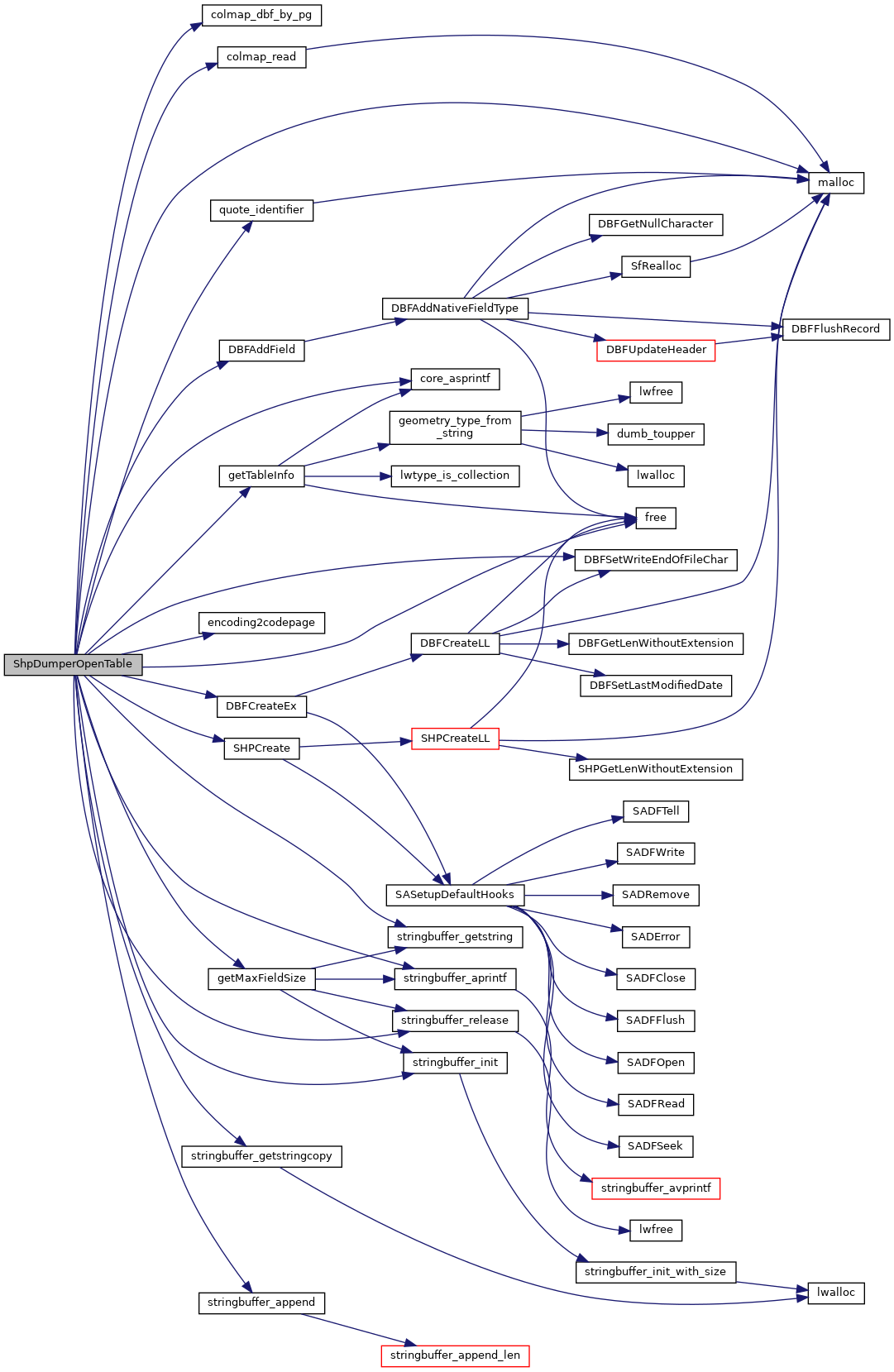
References _, shp_dumper_config::binary, colmap_dbf_by_pg(), colmap_read(), shp_dumper_state::column_map, shp_dumper_config::column_map_filename, shp_dumper_state::config, shp_dumper_state::conn, core_asprintf(), shp_dumper_state::currescount, shp_dumper_state::curresrow, shp_dumper_state::currow, shp_dumper_state::dbf, DBFAddField(), DBFCreateEx(), shp_dumper_state::dbffieldnames, shp_dumper_state::dbffieldtypes, DBFSetWriteEndOfFileChar(), encoding2codepage(), shp_dumper_state::fetch_query, shp_dumper_state::fetchres, shp_dumper_config::fetchsize, shp_dumper_state::fieldcount, free(), FTDate, FTDouble, FTInteger, FTLogical, FTString, shp_dumper_config::geo_col_name, shp_dumper_state::geo_col_name, shp_dumper_state::geog_oid, shp_dumper_state::geom_oid, getMaxFieldSize(), getTableInfo(), shp_dumper_config::includegid, shp_dumper_config::keep_fieldname_case, LWDEBUGF, shp_dumper_state::main_scan_query, malloc(), MAX_DBF_FIELD_SIZE, shp_dumper_state::message, shp_dumper_state::outshptype, shp_dumper_state::outtype, shp_dumper_state::pgfieldlens, shp_dumper_state::pgfieldnames, shp_dumper_state::pgfieldtypmods, shp_dumper_state::pgis_major_version, quote_identifier(), shp_dumper_state::rowcount, shp_dumper_config::schema, shp_dumper_state::schema, shp_dumper_state::shp, shp_dumper_config::shp_file, shp_dumper_state::shp_file, SHPCreate(), SHPDUMPERERR, SHPDUMPERMSGLEN, SHPDUMPEROK, SHPDUMPERWARN, stringbuffer_append(), stringbuffer_aprintf(), stringbuffer_getstring(), stringbuffer_getstringcopy(), stringbuffer_init(), stringbuffer_release(), shp_dumper_config::table, shp_dumper_state::table, shp_dumper_config::unescapedattrs, and shp_dumper_config::usrquery.

Referenced by main(), and pgui_action_export().

Here is the call graph for this function:
Here is the caller graph for this function: