Loading...
Searching...
No Matches
◆ lwt_GetEdgeByPoint()
| LWT_ELEMID lwt_GetEdgeByPoint | ( | LWT_TOPOLOGY * | topo, |
| LWPOINT * | pt, | ||
| double | tol | ||
| ) |
Find the edge-id of an edge that intersects a given point.
- Parameters
-
topo the topology to operate on point the point to use for query tol max distance around the given point to look for an intersecting edge
- Returns
- an edge identifier if one is found, 0 if none is found, -1 on error (multiple edges within distance). The liblwgeom error handler will be invoked in case of error.
Definition at line 4980 of file lwgeom_topo.c.
4981{
4982 LWT_ISO_EDGE *elem;
4983 uint64_t num, i;
4987
4989 {
4991 return -1;
4992 }
4993 elem = lwt_be_getEdgeWithinDistance2D(topo, pt, tol, &num, flds, 0);
4994 if (num == UINT64_MAX)
4995 {
4996 PGTOPO_BE_ERROR();
4997 return -1;
4998 }
4999 for (i=0; i<num;++i)
5000 {
5001 LWT_ISO_EDGE *e = &(elem[i]);
5002#if 0
5003 LWGEOM* geom;
5004 double dist;
5005
5007 {
5008 _lwt_release_edges(elem, num);
5011 continue;
5012 }
5013
5014 /* Should we check for intersection not being on an endpoint
5015 * as documented ? */
5017 dist = lwgeom_mindistance2d_tolerance(geom, qp, tol);
5018 if ( dist > tol ) continue;
5019#endif
5020
5021 if ( id )
5022 {
5023 _lwt_release_edges(elem, num);
5025 return -1;
5026 }
5028 }
5029
5031
5032 return id;
5033}
double lwgeom_mindistance2d_tolerance(const LWGEOM *lw1, const LWGEOM *lw2, double tolerance)
Function handling min distance calculations and dwithin calculations.
Definition measures.c:222
void lwnotice(const char *fmt,...) __attribute__((format(printf
Write a notice out to the notice handler.
void void lwerror(const char *fmt,...) __attribute__((format(printf
Write a notice out to the error handler.
LWT_ISO_EDGE * lwt_be_getEdgeWithinDistance2D(LWT_TOPOLOGY *topo, const LWPOINT *pt, double dist, uint64_t *numelems, int fields, int64_t limit)
Definition lwgeom_topo.c:305
void _lwt_release_edges(LWT_ISO_EDGE *edges, int num_edges)
Definition lwgeom_topo.c:520
static int lwgeom_is_empty(const LWGEOM *geom)
Return true or false depending on whether a geometry is an "empty" geometry (no vertices members)
Definition lwinline.h:199
Definition liblwgeom.h:457
References _lwt_release_edges(), LWT_ISO_EDGE::edge_id, LWT_ISO_EDGE::geom, lwerror(), lwgeom_is_empty(), lwgeom_mindistance2d_tolerance(), lwline_as_lwgeom(), lwnotice(), lwpoint_as_lwgeom(), lwt_be_getEdgeWithinDistance2D(), LWT_COL_EDGE_EDGE_ID, LWT_COL_EDGE_GEOM, LWTFMT_ELEMID, and PGTOPO_BE_ERROR.
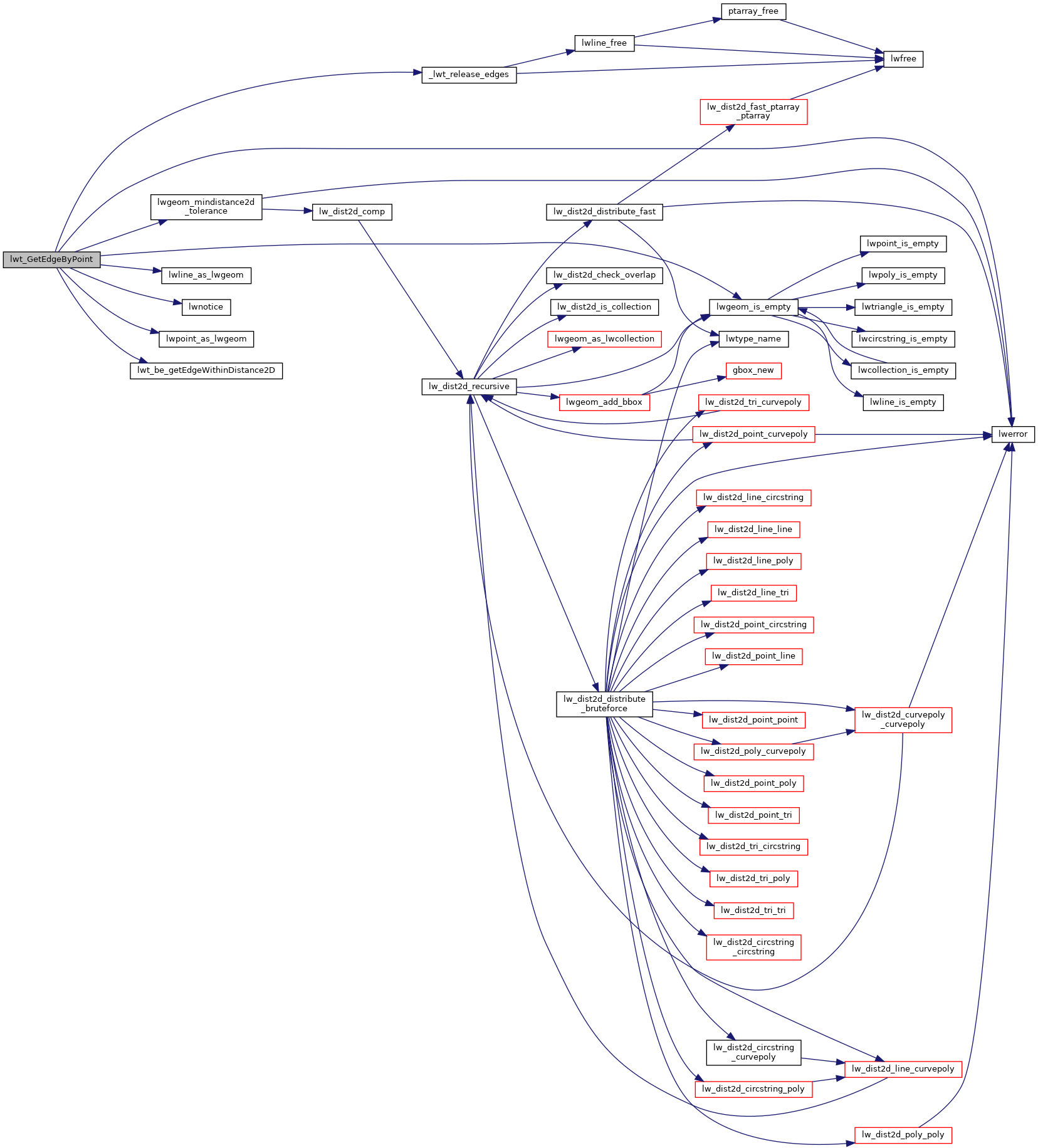
Here is the call graph for this function: