Loading...
Searching...
No Matches
◆ lwpoly_from_wkb_state()
|
static |
POLYGON Read a WKB polygon, starting just after the endian byte, type number and optional srid number.
Advance the parse state forward appropriately. First read the number of rings, then read each ring (which are structured as point arrays)
Definition at line 538 of file lwin_wkb.c.
539{
542 return NULL;
543 uint32_t i = 0;
545
547
548 /* Empty polygon? */
549 if( nrings == 0 )
550 return poly;
551
552 for( i = 0; i < nrings; i++ )
553 {
555 if (pa == NULL)
556 {
557 lwpoly_free(poly);
558 return NULL;
559 }
560
561 /* Check for at least four points. */
563 {
564 lwpoly_free(poly);
565 ptarray_free(pa);
568 return NULL;
569 }
570
571 /* Check that first and last points are the same. */
573 {
574 lwpoly_free(poly);
575 ptarray_free(pa);
578 return NULL;
579 }
580
581 /* Add ring to polygon */
583 {
584 lwpoly_free(poly);
585 ptarray_free(pa);
588 return NULL;
589 }
590
591 }
592 return poly;
593}
const char * lwtype_name(uint8_t type)
Return the type name string associated with a type number (e.g.
Definition lwutil.c:216
int lwpoly_add_ring(LWPOLY *poly, POINTARRAY *pa)
Add a ring, allocating extra space if necessary.
Definition lwpoly.c:247
LWPOLY * lwpoly_construct_empty(int32_t srid, char hasz, char hasm)
Definition lwpoly.c:161
void void lwerror(const char *fmt,...) __attribute__((format(printf
Write a notice out to the error handler.
static uint32_t integer_from_wkb_state(wkb_parse_state *s)
Int32 Read 4-byte integer and advance the parse state forward.
Definition lwin_wkb.c:285
static POINTARRAY * ptarray_from_wkb_state(wkb_parse_state *s)
POINTARRAY Read a dynamically sized point array and advance the parse state forward.
Definition lwin_wkb.c:347
Definition liblwgeom.h:517
Definition liblwgeom.h:426
References integer_from_wkb_state(), LW_FAILURE, LW_PARSER_CHECK_CLOSURE, LW_PARSER_CHECK_MINPOINTS, LWDEBUG, LWDEBUGF, lwerror(), lwpoly_add_ring(), lwpoly_construct_empty(), lwpoly_free(), lwtype_name(), POINTARRAY::npoints, ptarray_free(), ptarray_from_wkb_state(), ptarray_is_closed_2d(), and s.
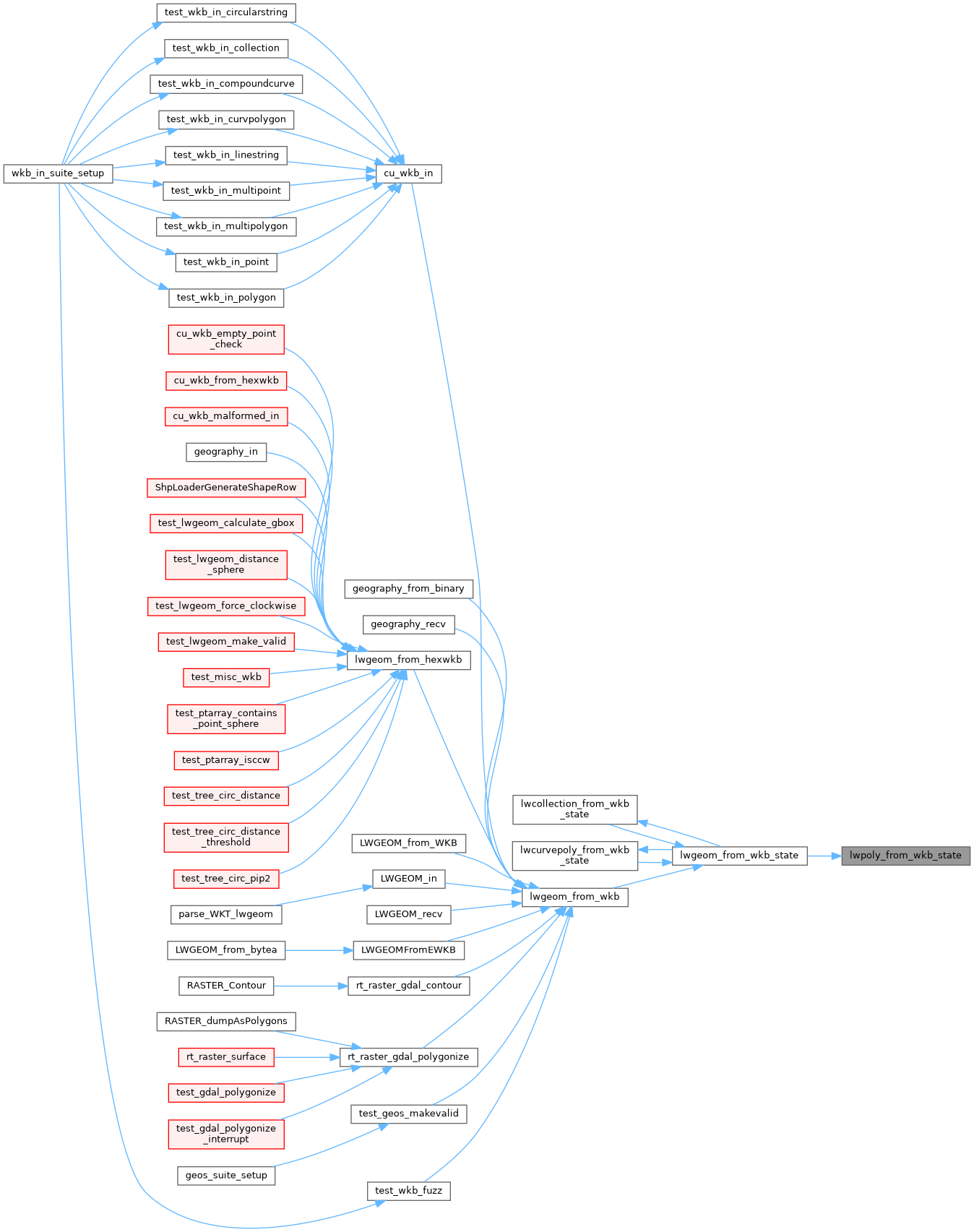
Referenced by lwgeom_from_wkb_state().
Here is the call graph for this function:
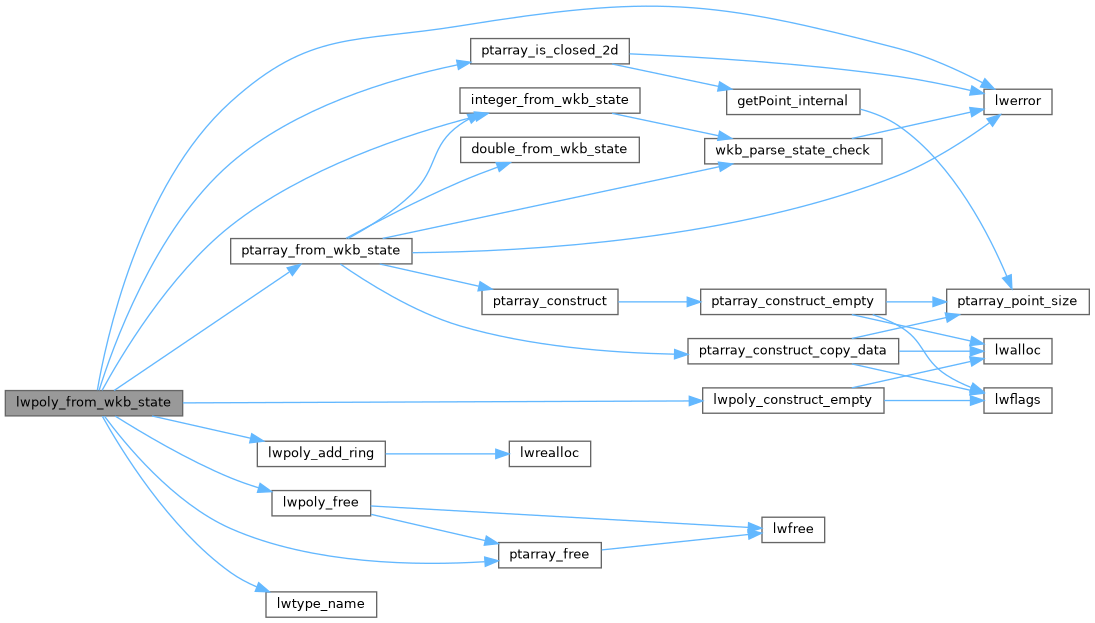
Here is the caller graph for this function: