Loading...
Searching...
No Matches
◆ ptarray_from_wkb_state()
|
static |
POINTARRAY Read a dynamically sized point array and advance the parse state forward.
First read the number of points, then read the points.
Definition at line 347 of file lwin_wkb.c.
348{
349 POINTARRAY *pa = NULL;
350 size_t pa_size;
351 uint32_t ndims = 2;
352 uint32_t npoints = 0;
354
355 /* Calculate the size of this point array. */
358 return NULL;
359
360 if (npoints > maxpoints)
361 {
364 return NULL;
365 }
366
368
371 pa_size = (size_t)npoints * ndims * WKB_DOUBLE_SIZE;
372
373 /* Empty! */
374 if( npoints == 0 )
376
377 /* Does the data we want to read exist? */
380 return NULL;
381
382 /* If we're in a native endianness, we can just copy the data directly! */
384 {
386 s->pos += pa_size;
387 }
388 /* Otherwise we have to read each double, separately. */
389 else
390 {
391 uint32_t i = 0;
392 double *dlist;
395 for( i = 0; i < npoints * ndims; i++ )
396 {
398 }
399 }
400
401 return pa;
402}
POINTARRAY * ptarray_construct_copy_data(char hasz, char hasm, uint32_t npoints, const uint8_t *ptlist)
Construct a new POINTARRAY, copying in the data from ptlist.
Definition ptarray.c:305
POINTARRAY * ptarray_construct(char hasz, char hasm, uint32_t npoints)
Construct an empty pointarray, allocating storage and setting the npoints, but not filling in any inf...
Definition ptarray.c:51
#define WKB_DOUBLE_SIZE
Well-Known Binary (WKB) Output Variant Types.
Definition liblwgeom_internal.h:96
void void lwerror(const char *fmt,...) __attribute__((format(printf
Write a notice out to the error handler.
static uint32_t integer_from_wkb_state(wkb_parse_state *s)
Int32 Read 4-byte integer and advance the parse state forward.
Definition lwin_wkb.c:285
static void wkb_parse_state_check(wkb_parse_state *s, size_t next)
Check that we are not about to read off the end of the WKB array.
Definition lwin_wkb.c:131
static double double_from_wkb_state(wkb_parse_state *s)
Double Read an 8-byte double and advance the parse state forward.
Definition lwin_wkb.c:317
Definition liblwgeom.h:426
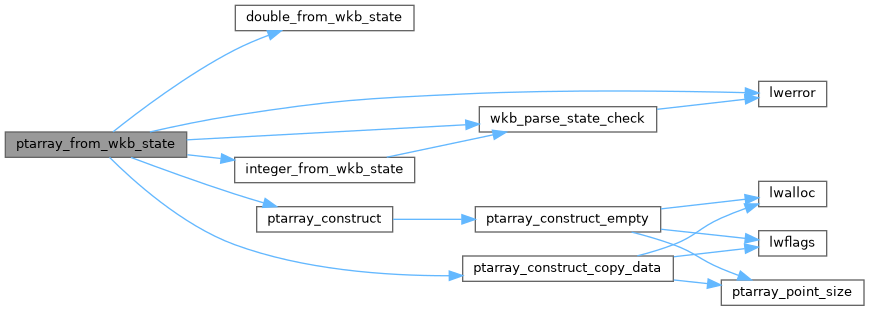
References double_from_wkb_state(), integer_from_wkb_state(), LW_TRUE, LWDEBUGF, lwerror(), ptarray_construct(), ptarray_construct_copy_data(), s, POINTARRAY::serialized_pointlist, WKB_DOUBLE_SIZE, and wkb_parse_state_check().
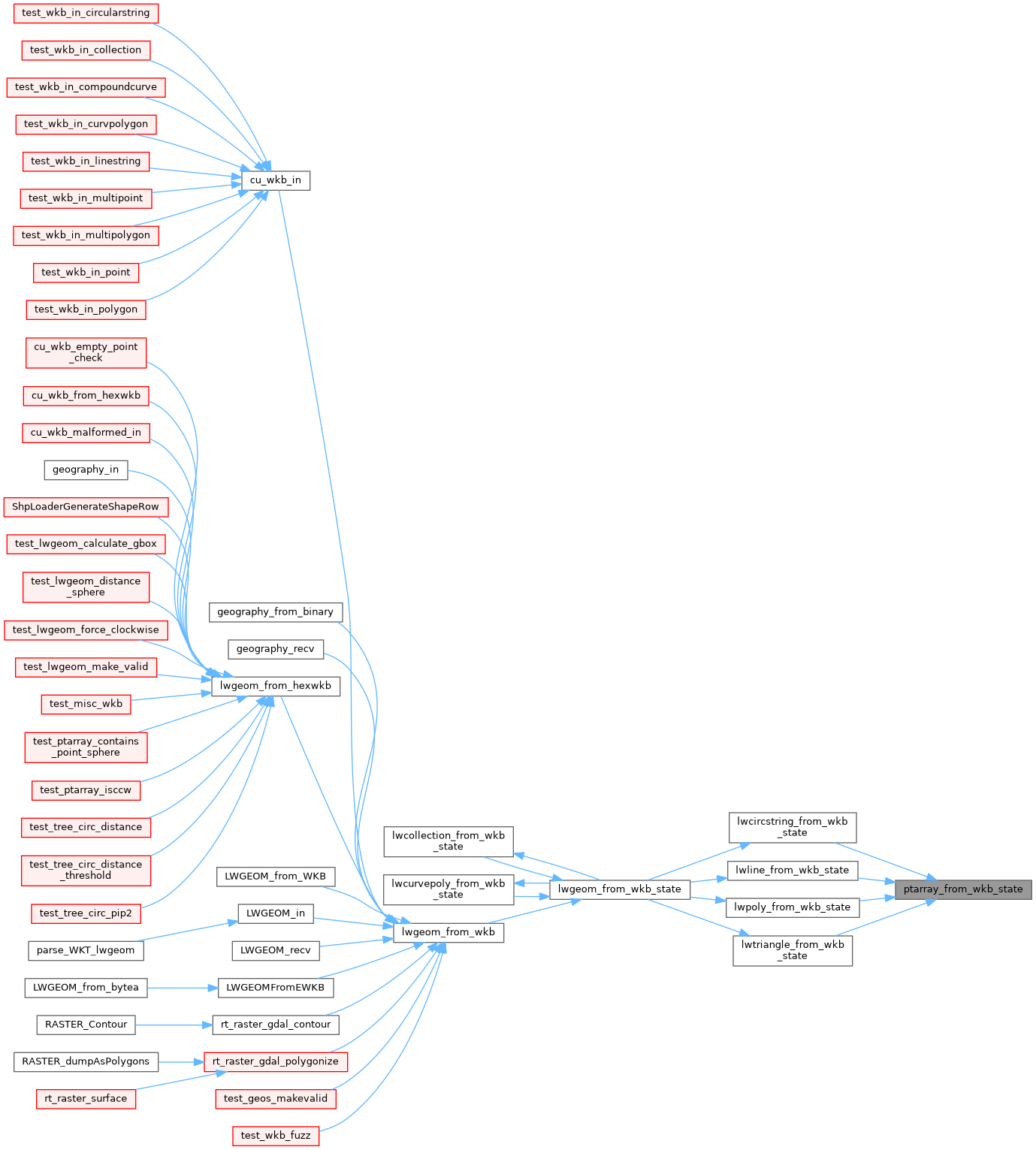
Referenced by lwcircstring_from_wkb_state(), lwline_from_wkb_state(), lwpoly_from_wkb_state(), and lwtriangle_from_wkb_state().
Here is the call graph for this function:
Here is the caller graph for this function: