Name
ST_HexagonGrid — Gibt eine Menge von Sechsecken und Zellindizes zurück, die die Grenzen des Arguments Geometrie vollständig abdecken.
Übersicht
setof record ST_HexagonGrid(float8 size, geometry bounds);
Beschreibung
Starts with the concept of a hexagon tiling of the plane. (Not a hexagon tiling of the globe; for H3 use the h3-pg extension.) For a given planar SRS, and a given edge size, starting at the origin of the SRS, there is one unique hexagonal tiling of the plane, Tiling(SRS, Size). This function answers the question: what hexagons in a given Tiling(SRS, Size) overlap with a given bounds.
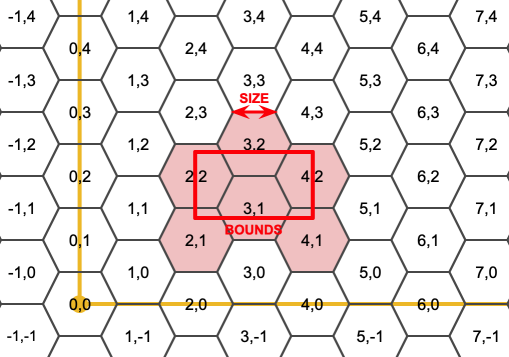
Die SRS für die Ausgangssechsecke ist die SRS, die durch die Begrenzungsgeometrie bereitgestellt wird.
Durch Verdoppelung oder Verdreifachung der Kantengröße des Sechsecks wird eine neue übergeordnete Kachel erzeugt, die zur ursprünglichen Kachel passt. Leider ist es nicht möglich, übergeordnete Sechseckkacheln zu erzeugen, in die die untergeordneten Kacheln perfekt hineinpassen.
Verfügbarkeit: 2.1.0
Beispiele
Unit hexagons covering rectangular bounds.
WITH bounds AS (
    SELECT ST_MakeEnvelope(2, 1, 4, 3, 3857) AS geom
), grid AS (
    SELECT hex.*
    FROM bounds
    CROSS JOIN LATERAL ST_HexagonGrid(1, geom) AS hex
)
SELECT (SELECT geom FROM bounds) AS input_bounds,
    ST_Collect(geom ORDER BY i, j) AS grid
FROM grid;
POLYGON((2 1,2 3,4 3,4 1,2 1)) | MULTIPOLYGON(((0.5 0.866,1 0,2 0,2.5 0.866,2 1.732,1 1.732,0.5 0.866)),((0.5 2.598,1 1.732,2 1.732,2.5 2.598,2 3.464,1 3.464,0.5 2.598)),((2 1.732,2.5 0.866,3.5 0.866,4 1.732,3.5 2.598,2.5 2.598,2 1.732)),((2 3.464,2.5 2.598,3.5 2.598,4 3.464,3.5 4.33,2.5 4.33,2 3.464)),((3.5 0.866,4 0,5 0,5.5 0.866,5 1.732,4 1.732,3.5 0.866)),((3.5 2.598,4 1.732,5 1.732,5.5 2.598,5 3.464,4 3.464,3.5 2.598)))
Child tiles that intersect a doubled-size parent hexagon share the tiling origin, but do not nest perfectly inside the parent.
WITH parent AS (
    SELECT ST_Hexagon(2, 0, 0) AS geom
), children AS (
    SELECT child.*
    FROM parent
    CROSS JOIN LATERAL ST_HexagonGrid(1, geom) AS child
    WHERE ST_Area(ST_Intersection(child.geom, parent.geom)) > 0
)
SELECT ST_Collect(geom ORDER BY i, j) AS children,
    (SELECT geom FROM parent) AS parent
FROM children;
MULTIPOLYGON(((-2.5 -0.866,-2 -1.732,-1 -1.732,-0.5 -0.866,-1 0,-2 0,-2.5 -0.866)),((-2.5 0.866,-2 0,-1 0,-0.5 0.866,-1 1.732,-2 1.732,-2.5 0.866)),((-1 -1.732,-0.5 -2.598,0.5 -2.598,1 -1.732,0.5 -0.866,-0.5 -0.866,-1 -1.732)),((-1 0,-0.5 -0.866,0.5 -0.866,1 0,0.5 0.866,-0.5 0.866,-1 0)),((-1 1.732,-0.5 0.866,0.5 0.866,1 1.732,0.5 2.598,-0.5 2.598,-1 1.732)),((0.5 -0.866,1 -1.732,2 -1.732,2.5 -0.866,2 0,1 0,0.5 -0.866)),((0.5 0.866,1 0,2 0,2.5 0.866,2 1.732,1 1.732,0.5 0.866))) | POLYGON((-2 0,-1 -1.732,1 -1.732,2 0,1 1.732,-1 1.732,-2 0))
Counting points in hexagons.
Um eine Punktzusammenfassung anhand eines sechseckigen Kachels vorzunehmen, erstellen Sie ein Sechseckgitter, wobei Sie die Ausdehnung der Punkte als Grenzen verwenden, und verbinden Sie es dann räumlich mit diesem Gitter.
SELECT COUNT(*), hexes.geom
FROM ST_HexagonGrid(
  10000,
  ST_SetSRID(ST_EstimatedExtent('pointtable', 'geom'), 3857)
) AS hexes
INNER JOIN pointtable AS pts
  ON ST_Intersects(pts.geom, hexes.geom)
GROUP BY hexes.geom;
Generating hex coverage of polygons.
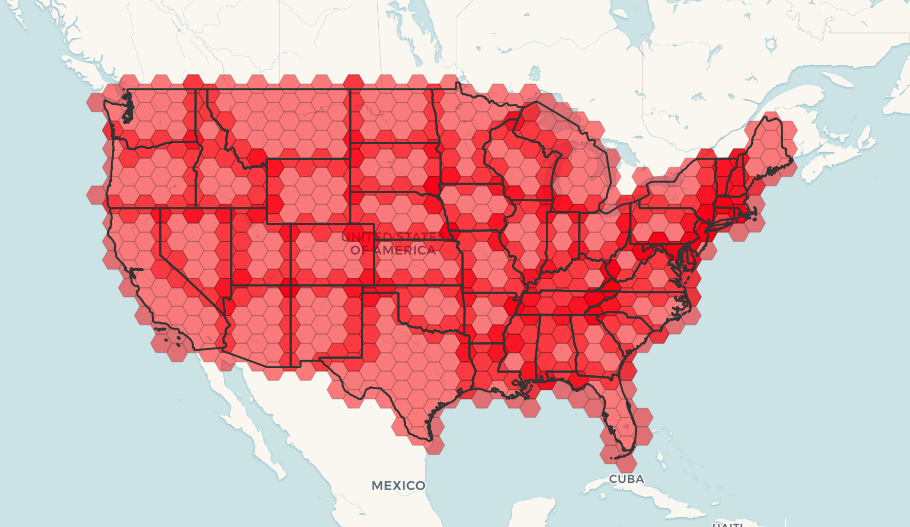
If a grid is generated for each polygon boundary and filtered to intersecting cells, adjacent regions receive overlapping hexagons along their shared border. The build-time figure below uses two simple regions in place of an external administrative-boundary table, so the example is self-contained.
WITH admin1(gid, geom) AS (
    VALUES
        (1, ST_MakeEnvelope(0, 0, 3, 3, 3857)),
        (2, ST_MakeEnvelope(3, 0, 6, 3, 3857))
), coverage AS (
    SELECT hex.i, hex.j, hex.geom
    FROM admin1
    CROSS JOIN LATERAL ST_HexagonGrid(1.5, admin1.geom) AS hex
    WHERE ST_Intersects(admin1.geom, hex.geom)
    GROUP BY hex.i, hex.j, hex.geom
), layers AS (
    SELECT 'region' AS kind, gid AS position, geom
    FROM admin1
    UNION ALL
    SELECT
        'hexagon',
        1000 + row_number() OVER (ORDER BY i, j),
        geom
    FROM coverage
)
SELECT
    CASE kind WHEN 'region' THEN geom END AS input_region,
    CASE kind WHEN 'hexagon' THEN geom END AS hexagon
FROM layers
ORDER BY position;
POLYGON((0 0,0 3,3 3,3 0,0 0)) | null
POLYGON((3 0,3 3,6 3,6 0,3 0)) | null
null | POLYGON((-1.5 0,-0.75 -1.3,0.75 -1.3,1.5 0,0.75 1.3,-0.75 1.3,-1.5 0))
null | POLYGON((-1.5 2.6,-0.75 1.3,0.75 1.3,1.5 2.6,0.75 3.9,-0.75 3.9,-1.5 2.6))
null | POLYGON((0.75 1.3,1.5 0,3 0,3.75 1.3,3 2.6,1.5 2.6,0.75 1.3))
null | POLYGON((0.75 3.9,1.5 2.6,3 2.6,3.75 3.9,3 5.2,1.5 5.2,0.75 3.9))
null | POLYGON((3 0,3.75 -1.3,5.25 -1.3,6 0,5.25 1.3,3.75 1.3,3 0))
null | POLYGON((3 2.6,3.75 1.3,5.25 1.3,6 2.6,5.25 3.9,3.75 3.9,3 2.6))
null | POLYGON((5.25 1.3,6 0,7.5 0,8.25 1.3,7.5 2.6,6 2.6,5.25 1.3))
null | POLYGON((5.25 3.9,6 2.6,7.5 2.6,8.25 3.9,7.5 5.2,6 5.2,5.25 3.9))
The same pattern applies to a real administrative-boundary table:
![[Anmerkung]](../images/note.png)
|
|
|
Das Schlüsselwort LATERAL wird für Funktionen mit Mengenrückgabe impliziert, wenn auf eine vorherige Tabelle in der FROM-Liste verwiesen wird. CROSS JOIN LATERAL, CROSS JOIN oder einfach nur , sind also gleichwertige Konstrukte für dieses Beispiel. |
SELECT admin1.gid, hex.geom
FROM
    admin1
    CROSS JOIN
    ST_HexagonGrid(100000, admin1.geom) AS hex
WHERE
    adm0_a3 = 'USA'
    AND
    ST_Intersects(admin1.geom, hex.geom)