Loading...
Searching...
No Matches
◆ ptarray_simplify_in_place()
| void ptarray_simplify_in_place | ( | POINTARRAY * | pa, |
| double | tolerance, | ||
| uint32_t | minpts | ||
| ) |
- Parameters
-
minpts minimum number of points to retain, if possible.
Definition at line 1856 of file ptarray.c.
1857{
1858 /* Do not try to simplify really short things */
1860 return;
1861
1862 if (tolerance == 0 && minpts <= 2)
1863 {
1864 ptarray_simplify_in_place_tolerance0(pa);
1865 return;
1866 }
1867
1868 /* We use this array to keep track of the points we are keeping, so
1869 * we store just TRUE / FALSE in their position */
1872 kept_points[0] = LW_TRUE;
1874 uint32_t keptn = 2;
1875
1876 /* We use this array as a stack to store the iterators that we are going to need
1877 * in the following steps.
1878 * This is ~10% faster than iterating over @kept_points looking for them
1879 */
1881 iterator_stack[0] = 0;
1882 uint32_t iterator_stack_size = 1;
1883
1884 uint32_t it_first = 0;
1885 uint32_t it_last = pa->npoints - 1;
1886
1887 const double tolerance_sqr = tolerance * tolerance;
1888 /* For the first @minpts points we ignore the tolerance */
1889 double it_tol = keptn >= minpts ? tolerance_sqr : -1.0;
1890
1891 while (iterator_stack_size)
1892 {
1893 uint32_t split = ptarray_dp_findsplit_in_place(pa, it_first, it_last, it_tol);
1894 if (split == it_first)
1895 {
1896 it_first = it_last;
1897 it_last = iterator_stack[--iterator_stack_size];
1898 }
1899 else
1900 {
1901 kept_points[split] = LW_TRUE;
1902 keptn++;
1903
1904 iterator_stack[iterator_stack_size++] = it_last;
1905 it_last = split;
1906 it_tol = keptn >= minpts ? tolerance_sqr : -1.0;
1907 }
1908 }
1909
1911 /* The first point is already in place, so we don't need to copy it */
1912 size_t kept_it = 1;
1913 if (keptn == 2)
1914 {
1915 /* If there are 2 points remaining, it has to be first and last as
1916 * we added those at the start */
1917 memcpy(pa->serialized_pointlist + pt_size * kept_it,
1919 pt_size);
1920 }
1921 else if (pa->npoints != keptn) /* We don't need to move any points if we are keeping them all */
1922 {
1924 {
1925 if (kept_points[i])
1926 {
1927 memcpy(pa->serialized_pointlist + pt_size * kept_it,
1928 pa->serialized_pointlist + pt_size * i,
1929 pt_size);
1930 kept_it++;
1931 }
1932 }
1933 }
1934 pa->npoints = keptn;
1935
1936 lwfree(kept_points);
1937 lwfree(iterator_stack);
1938}
static uint32_t ptarray_dp_findsplit_in_place(const POINTARRAY *pts, uint32_t it_first, uint32_t it_last, double max_distance_sqr)
Definition ptarray.c:1745
static void ptarray_simplify_in_place_tolerance0(POINTARRAY *pa)
Definition ptarray.c:1810
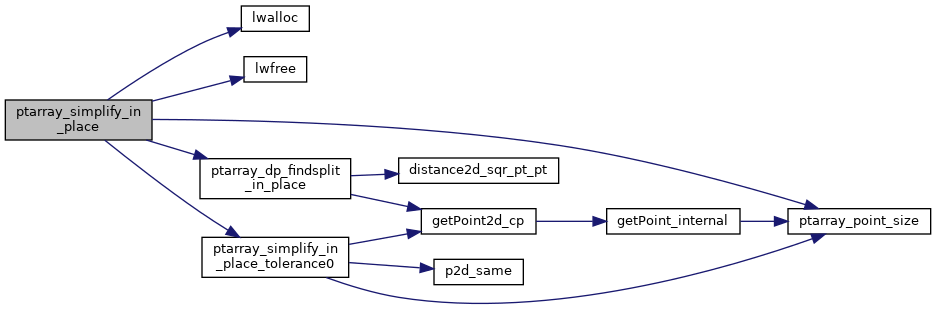
References LW_FALSE, LW_TRUE, lwalloc(), lwfree(), POINTARRAY::npoints, ptarray_dp_findsplit_in_place(), ptarray_point_size(), ptarray_simplify_in_place_tolerance0(), and POINTARRAY::serialized_pointlist.
Referenced by lwgeom_simplify_in_place(), and test_ptarray_simplify().
Here is the call graph for this function:
Here is the caller graph for this function: