Loading...
Searching...
No Matches
◆ lwgeom_concavehull()
Take a geometry and build the concave hull.
The concave hull is smaller than the convex hull, but still encompasses all the points of the input. For polygon input the hull encompasses all the input area. For line input the hull encompasses all the input lines.
- Parameters
-
g the input geometry ratio proportion of output vs input allow_holes can there be holes in the output. large performance penalty.
Definition at line 1892 of file liblwgeom/lwgeom_geos.c.
1893{
1895 int32_t srid = RESULT_SRID(geom);
1897 GEOSGeometry *g1, *g3;
1898 int geosGeomType;
1899
1901
1903
1904 geosGeomType = GEOSGeomTypeId(g1);
1905 if (geosGeomType == GEOS_POLYGON || geosGeomType == GEOS_MULTIPOLYGON) {
1907 g3 = GEOSConcaveHullOfPolygons(g1, ratio, is_tight, allow_holes);
1908 }
1909 else {
1910 g3 = GEOSConcaveHull(g1, ratio, allow_holes);
1911 }
1912
1913 if (!g3)
1914 GEOS_FREE_AND_FAIL(g1);
1915
1916 GEOSSetSRID(g3, srid);
1917
1919 GEOS_FREE_AND_FAIL(g1, g3);
1920
1921 GEOS_FREE(g1, g3);
1923}
GEOSGeometry * LWGEOM2GEOS(const LWGEOM *lwgeom, uint8_t autofix)
Definition liblwgeom/lwgeom_geos.c:400
void(*) LWGEOM GEOS2LWGEOM)(const GEOSGeometry *geom, uint8_t want3d)
Definition liblwgeom/lwgeom_geos.h:39
void lwnotice(const char *fmt,...) __attribute__((format(printf
Write a notice out to the notice handler.
Definition liblwgeom.h:457
References AUTOFIX, LWGEOM::flags, FLAGS_GET_Z, GEOS_FAIL, GEOS_FREE, GEOS_FREE_AND_FAIL, LW_FALSE, LWGEOM2GEOS(), lwgeom_geos_error(), lwnotice(), result, and RESULT_SRID.
Referenced by ST_ConcaveHull().
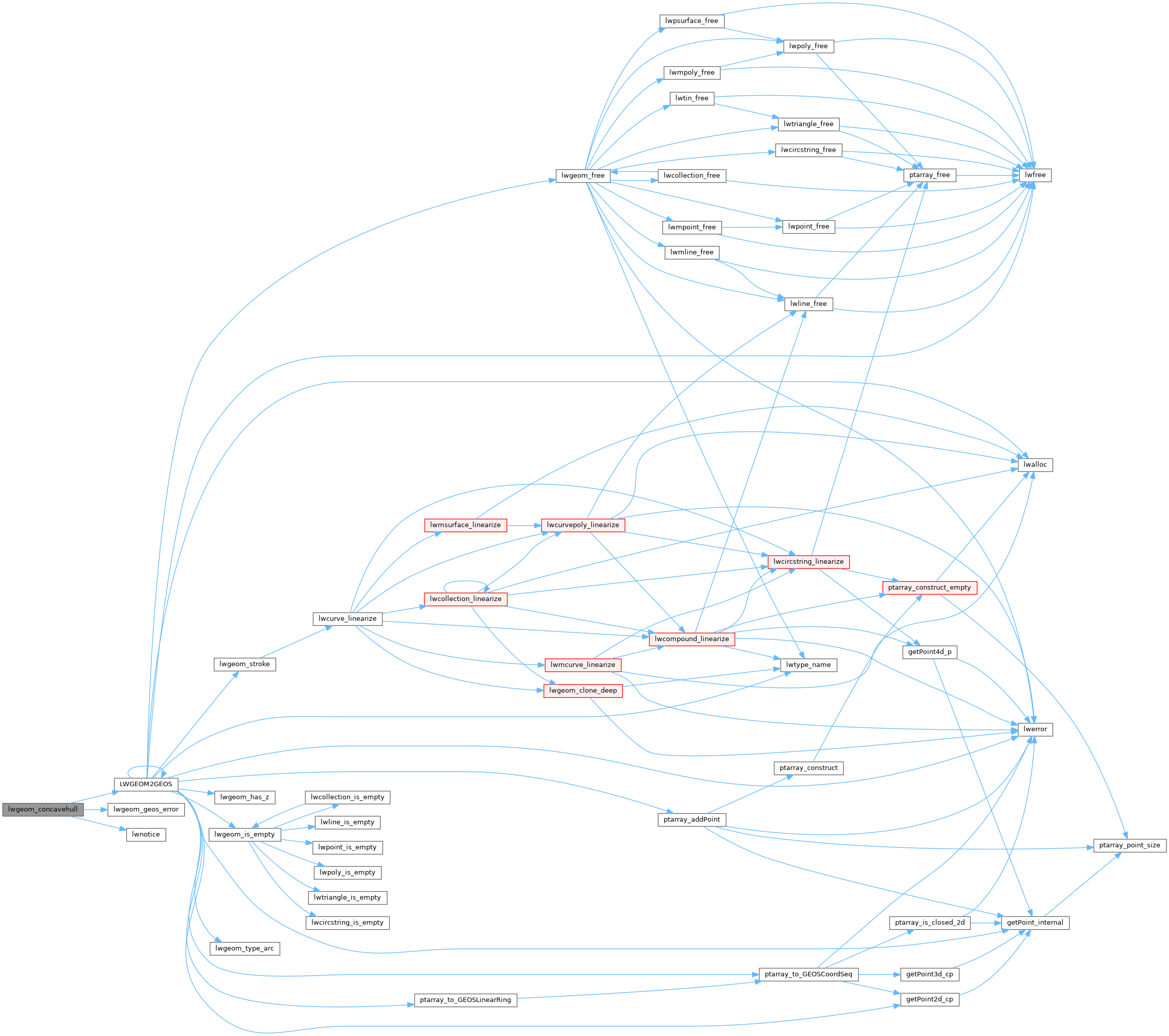
Here is the call graph for this function:
Here is the caller graph for this function: