Loading...
Searching...
No Matches
◆ lwgeom_cluster_kmeans()
| int * lwgeom_cluster_kmeans | ( | const LWGEOM ** | geoms, |
| uint32_t | n, | ||
| uint32_t | k, | ||
| double | max_radius | ||
| ) |
Take a list of LWGEOMs and a number of clusters and return an integer array indicating which cluster each geometry is in.
- Parameters
-
geoms the input array of LWGEOM pointers ngeoms the number of elements in the array k the number of clusters to calculate max_radius maximum radius of cluster before it's split
Definition at line 321 of file lwkmeans.c.
322{
323 uint32_t num_non_empty = 0;
324
325 assert(k > 0);
326 assert(n > 0);
327 assert(max_radius >= 0);
328 assert(geoms);
329
330 if (n < k)
331 {
332 lwerror(
333 "%s: number of geometries is less than the number of clusters requested, not all clusters will get data",
334 __func__);
335 k = n;
336 }
337
338 /* An array of objects to be analyzed. */
340
341 /* Array to mark unclusterable objects. Will be returned as KMEANS_NULL_CLUSTER. */
343 memset(geom_valid, 0, sizeof(uint8_t) * n);
344
345 /* Array to fill in with cluster numbers. */
347 for (uint32_t i = 0; i < n; i++)
348 clusters[i] = KMEANS_NULL_CLUSTER;
349
350 /* An array of clusters centers for the algorithm. */
353
354 /* An array of clusters radii for the algorithm. */
356 memset(radii, 0, sizeof(double) * n);
357
358 /* Prepare the list of object pointers for K-means */
359 for (uint32_t i = 0; i < n; i++)
360 {
362 /* Unset M values will be 1 */
363 POINT4D out = {0, 0, 0, 1};
364
365 /* Null/empty geometries get geom_valid=LW_FALSE set earlier with memset */
367 continue;
368
369 /* If the input is a point, use its coordinates */
371 {
377 {
381 __func__);
382 }
383 }
385 {
386 /* For 2D, we can take a centroid */
389 continue;
391 {
393 continue;
394 }
398 }
399 else
400 {
401 /* For 3D non-point, we can have a box center */
404 continue;
408 }
409 geom_valid[i] = LW_TRUE;
410 objs_dense[num_non_empty++] = out;
411 }
412
413 if (num_non_empty < k)
414 {
415 lwnotice(
416 "%s: number of non-empty geometries (%d) is less than the number of clusters (%d) requested, not all clusters will get data",
417 __func__,
418 num_non_empty,
419 k);
420 k = num_non_empty;
421 }
422
423 uint8_t converged = LW_TRUE;
424
425 if (num_non_empty > 0)
426 {
428 memset(clusters_dense, 0, sizeof(uint32_t) * num_non_empty);
429 uint32_t output_cluster_count = kmeans(objs_dense, clusters_dense, num_non_empty, centers, radii, k, max_radius);
430
431 uint32_t d = 0;
432 for (uint32_t i = 0; i < n; i++)
433 if (geom_valid[i])
434 clusters[i] = (int)clusters_dense[d++];
435
436 converged = output_cluster_count > 0;
437 lwfree(clusters_dense);
438 }
439
440 /* Before error handling, might as well clean up all the inputs */
441 lwfree(objs_dense);
442 lwfree(centers);
443 lwfree(geom_valid);
444 lwfree(radii);
445
446 /* Good result */
447 if (converged)
448 return clusters;
449
450 /* Bad result, not going to need the answer */
451 lwfree(clusters);
452 return NULL;
453}
int gbox_is_valid(const GBOX *gbox)
Return false if any of the dimensions is NaN or infinite.
Definition gbox.c:197
int lwgeom_has_z(const LWGEOM *geom)
Return LW_TRUE if geometry has Z ordinates.
Definition lwgeom.c:962
const GBOX * lwgeom_get_bbox(const LWGEOM *lwgeom)
Get a non-empty geometry bounding box, computing and caching it if not already there.
Definition lwgeom.c:771
int lwgeom_has_m(const LWGEOM *geom)
Return LW_TRUE if geometry has M ordinates.
Definition lwgeom.c:969
void lwnotice(const char *fmt,...) __attribute__((format(printf
Write a notice out to the notice handler.
void void lwerror(const char *fmt,...) __attribute__((format(printf
Write a notice out to the error handler.
static int lwgeom_is_empty(const LWGEOM *geom)
Return true or false depending on whether a geometry is an "empty" geometry (no vertices members)
Definition lwinline.h:199
static uint32_t kmeans(POINT4D *objs, uint32_t *clusters, uint32_t n, POINT4D *centers, double *radii, uint32_t min_k, double max_radius)
Definition lwkmeans.c:276
Definition liblwgeom.h:352
Definition liblwgeom.h:457
Definition liblwgeom.h:413
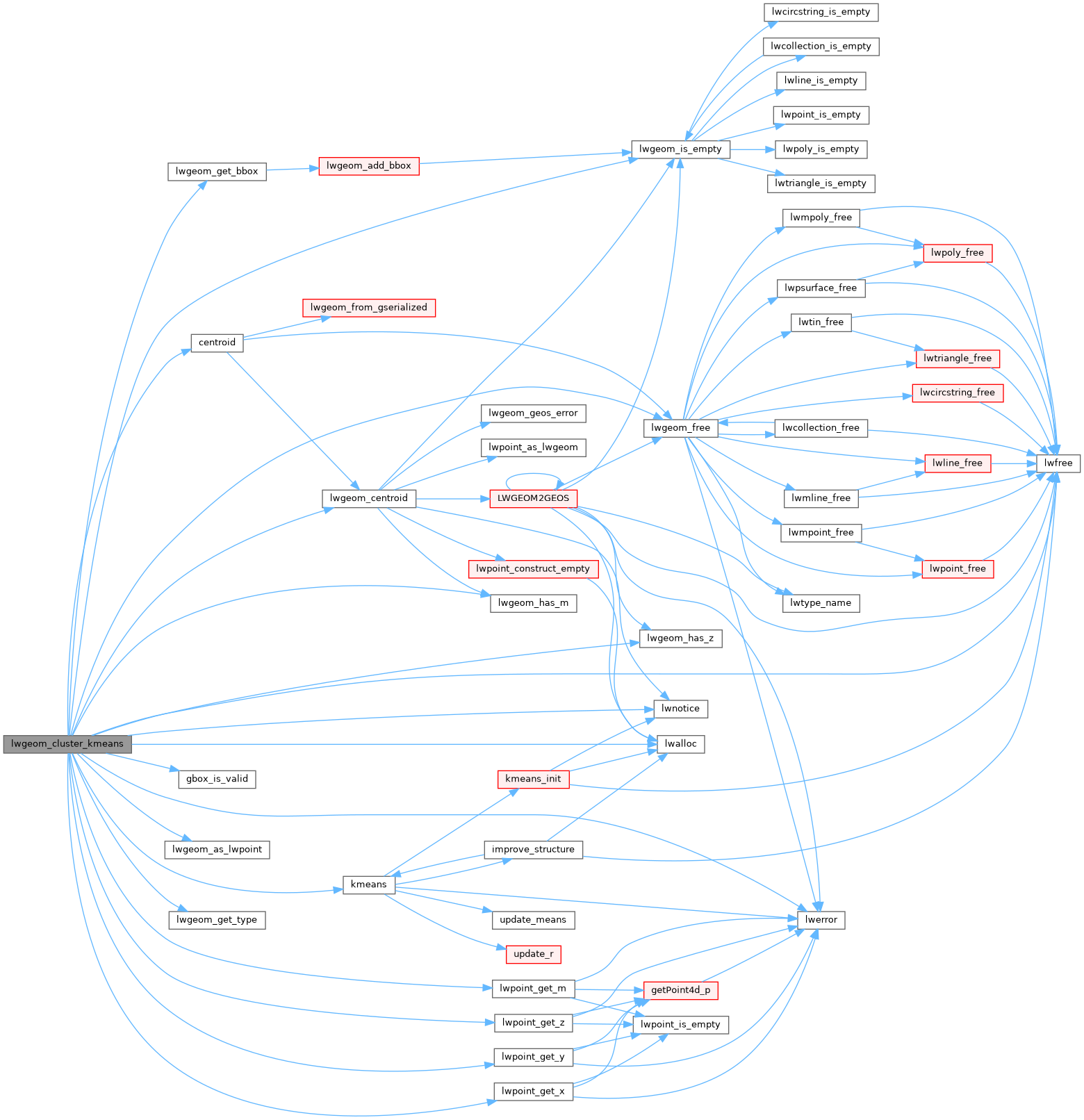
References centroid(), gbox_is_valid(), kmeans(), KMEANS_NULL_CLUSTER, LW_TRUE, lwalloc(), lwerror(), lwfree(), lwgeom_as_lwpoint(), lwgeom_centroid(), lwgeom_free(), lwgeom_get_bbox(), lwgeom_get_type(), lwgeom_has_m(), lwgeom_has_z(), lwgeom_is_empty(), lwnotice(), lwpoint_get_m(), lwpoint_get_x(), lwpoint_get_y(), lwpoint_get_z(), POINT4D::m, POINTTYPE, POINT4D::x, GBOX::xmax, GBOX::xmin, POINT4D::y, GBOX::ymax, GBOX::ymin, POINT4D::z, GBOX::zmax, and GBOX::zmin.
Referenced by ST_ClusterKMeans(), and test_kmeans().
Here is the call graph for this function:
Here is the caller graph for this function: