Loading...
Searching...
No Matches
◆ ptarray_set_effective_area()
|
static |
Definition at line 402 of file effectivearea.c.
403{
405 uint32_t p;
406 POINT4D pt;
407 EFFECTIVE_AREAS *ea;
409 int set_m;
410 if(set_area)
411 set_m=1;
412 else
414 ea=initiate_effectivearea(inpts);
415
417
418 ptarray_calc_areas(ea,avoid_collaps,set_area,trshld);
419
420 if(set_area)
421 {
422 /*Only return points with an effective area above the threshold*/
424 {
426 {
430 }
431 }
432 }
433 else
434 {
435 /*Only return points with an effective area above the threshold*/
437 {
439 {
442 }
443 }
444 }
445 destroy_effectivearea(ea);
446
448
449}
void ptarray_calc_areas(EFFECTIVE_AREAS *ea, int avoid_collaps, int set_area, double trshld)
We calculate the effective area for the first time.
Definition effectivearea.c:349
EFFECTIVE_AREAS * initiate_effectivearea(const POINTARRAY *inpts)
Definition effectivearea.c:30
POINTARRAY * ptarray_construct_empty(char hasz, char hasm, uint32_t maxpoints)
Create a new POINTARRAY with no points.
Definition ptarray.c:59
int ptarray_append_point(POINTARRAY *pa, const POINT4D *pt, int allow_duplicates)
Append a point to the end of an existing POINTARRAY If allow_duplicate is LW_FALSE,...
Definition ptarray.c:147
Definition liblwgeom.h:413
Definition liblwgeom.h:426
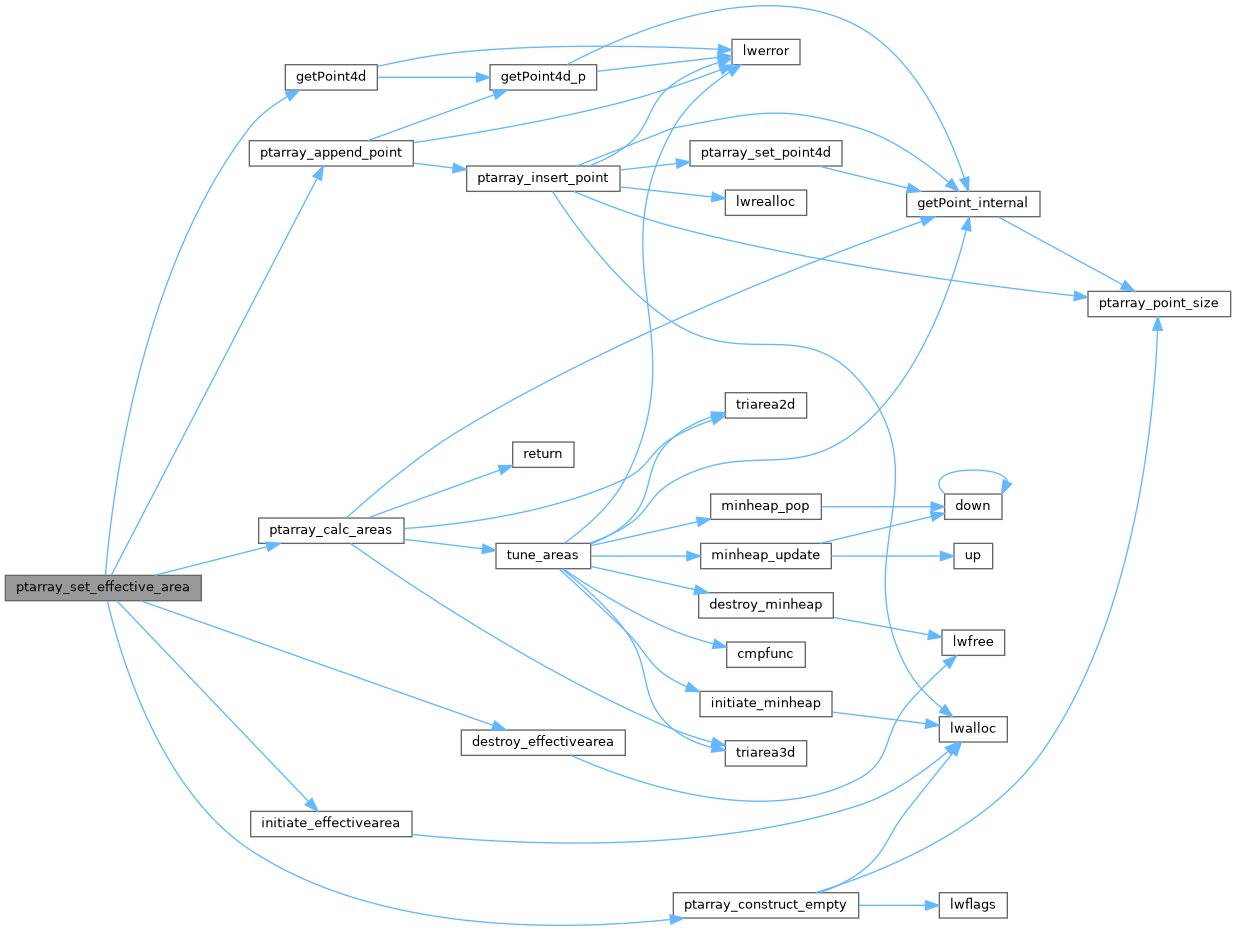
References destroy_effectivearea(), POINTARRAY::flags, FLAGS_GET_M, FLAGS_GET_Z, getPoint4d(), initiate_effectivearea(), EFFECTIVE_AREAS::inpts, LW_TRUE, LWDEBUG, POINT4D::m, POINTARRAY::npoints, ptarray_append_point(), ptarray_calc_areas(), ptarray_construct_empty(), and EFFECTIVE_AREAS::res_arealist.
Referenced by lwline_set_effective_area(), and lwpoly_set_effective_area().
Here is the call graph for this function:
Here is the caller graph for this function: