Loading...
Searching...
No Matches
◆ ST_InterpolatePoint()
| Datum ST_InterpolatePoint | ( | PG_FUNCTION_ARGS | ) |
Definition at line 184 of file lwgeom_functions_lrs.c.
185{
186 GSERIALIZED *gser_line = PG_GETARG_GSERIALIZED_P(0);
187 GSERIALIZED *gser_point = PG_GETARG_GSERIALIZED_P(1);
188 LWGEOM *lwline;
189 LWPOINT *lwpoint;
190
192 {
193 elog(ERROR,"ST_InterpolatePoint: 1st argument isn't a line");
194 PG_RETURN_NULL();
195 }
197 {
198 elog(ERROR,"ST_InterpolatePoint: 2nd argument isn't a point");
199 PG_RETURN_NULL();
200 }
201
202 gserialized_error_if_srid_mismatch(gser_line, gser_point, __func__);
203
205 {
206 elog(ERROR,"ST_InterpolatePoint only accepts geometries that have an M dimension");
207 PG_RETURN_NULL();
208 }
209
211 lwline = lwgeom_from_gserialized(gser_line);
212
213 PG_RETURN_FLOAT8(lwgeom_interpolate_point(lwline, lwpoint));
214}
void gserialized_error_if_srid_mismatch(const GSERIALIZED *g1, const GSERIALIZED *g2, const char *funcname)
Definition gserialized.c:432
LWGEOM * lwgeom_from_gserialized(const GSERIALIZED *g)
Allocate a new LWGEOM from a GSERIALIZED.
Definition gserialized.c:268
int gserialized_has_m(const GSERIALIZED *g)
Check if a GSERIALIZED has an M ordinate.
Definition gserialized.c:214
uint32_t gserialized_get_type(const GSERIALIZED *g)
Extract the geometry type from the serialized form (it hides in the anonymous data area,...
Definition gserialized.c:118
double lwgeom_interpolate_point(const LWGEOM *lwin, const LWPOINT *lwpt)
Find the measure value at the location on the line closest to the point.
Definition lwlinearreferencing.c:920
Definition liblwgeom.h:443
Definition liblwgeom.h:457
Definition liblwgeom.h:469
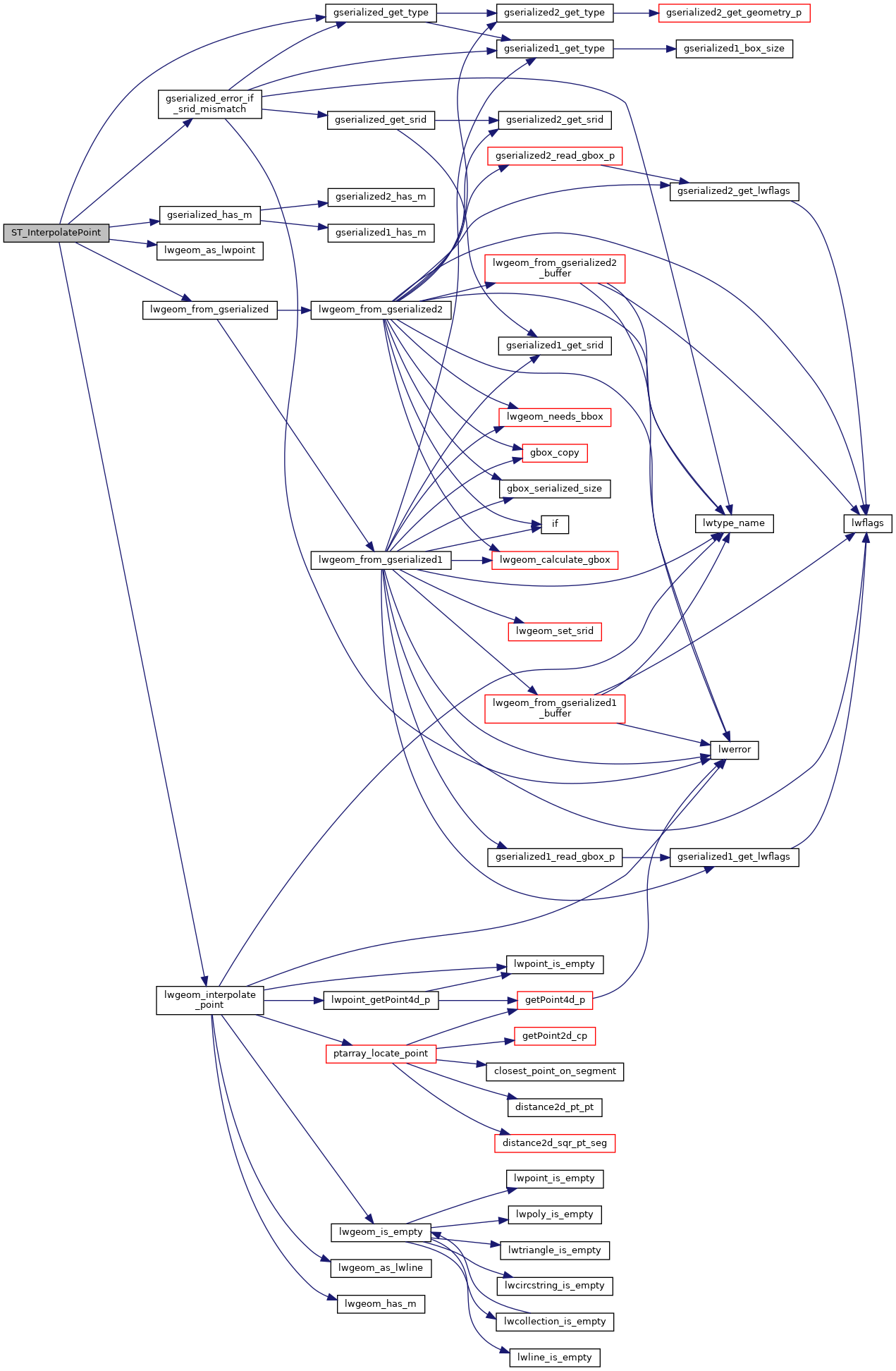
References gserialized_error_if_srid_mismatch(), gserialized_get_type(), gserialized_has_m(), LINETYPE, lwgeom_as_lwpoint(), lwgeom_from_gserialized(), lwgeom_interpolate_point(), and POINTTYPE.
Here is the call graph for this function: