Loading...
Searching...
No Matches
◆ lwline_extend()
|
extern |
Extend the ends of a line.
Definition at line 682 of file lwline.c.
683{
684 POINTARRAY *pa, *opa;
685 POINT4D p00, p01, p10, p11;
686 POINT4D p_start, p_end;
687 uint32_t i;
688 bool forward = false, backward = false;
689
690 if (distance_forward < 0 || distance_backward < 0)
692
694 {
696 }
697
698 pa = line->points;
699 if (distance_backward > 0.0)
700 {
701 i = 0;
702 /* Get two distinct points at start of pointarray */
703 getPoint4d_p(pa, i++, &p00);
704 getPoint4d_p(pa, i, &p01);
706 {
708 {
710 }
711 i++;
712 getPoint4d_p(pa, i, &p01);
713 }
714 project_pt_pt(&p01, &p00, distance_backward, &p_start);
715 backward = true;
716 }
717
718 if (distance_forward > 0.0)
719 {
720 i = pa->npoints - 1;
721 /* Get two distinct points at end of pointarray */
722 getPoint4d_p(pa, i--, &p10);
723 getPoint4d_p(pa, i, &p11);
725 {
726 if (i == 0)
727 {
729 }
730 i--;
731 getPoint4d_p(pa, i, &p11);
732 }
733 project_pt_pt(&p11, &p10, distance_forward, &p_end);
734 forward = true;
735 }
736
738
739 if (backward)
740 {
742 }
743 ptarray_append_ptarray(opa, pa, -1.0);
744 if (forward)
745 {
747 }
749}
int ptarray_append_ptarray(POINTARRAY *pa1, POINTARRAY *pa2, double gap_tolerance)
Append a POINTARRAY, pa2 to the end of an existing POINTARRAY, pa1.
Definition ptarray.c:177
POINTARRAY * ptarray_construct_empty(char hasz, char hasm, uint32_t maxpoints)
Create a new POINTARRAY with no points.
Definition ptarray.c:59
int getPoint4d_p(const POINTARRAY *pa, uint32_t n, POINT4D *point)
Definition lwgeom_api.c:125
int ptarray_append_point(POINTARRAY *pa, const POINT4D *pt, int allow_duplicates)
Append a point to the end of an existing POINTARRAY If allow_duplicate is LW_FALSE,...
Definition ptarray.c:147
int lwline_is_empty(const LWLINE *line)
int project_pt_pt(const POINT4D *A, const POINT4D *B, double distance, POINT4D *R)
Azimuth is angle in radians from vertical axis.
Definition measures.c:2445
void void lwerror(const char *fmt,...) __attribute__((format(printf
Write a notice out to the error handler.
LWLINE * lwline_construct(int32_t srid, GBOX *bbox, POINTARRAY *points)
Definition lwline.c:42
Definition liblwgeom.h:413
Definition liblwgeom.h:426
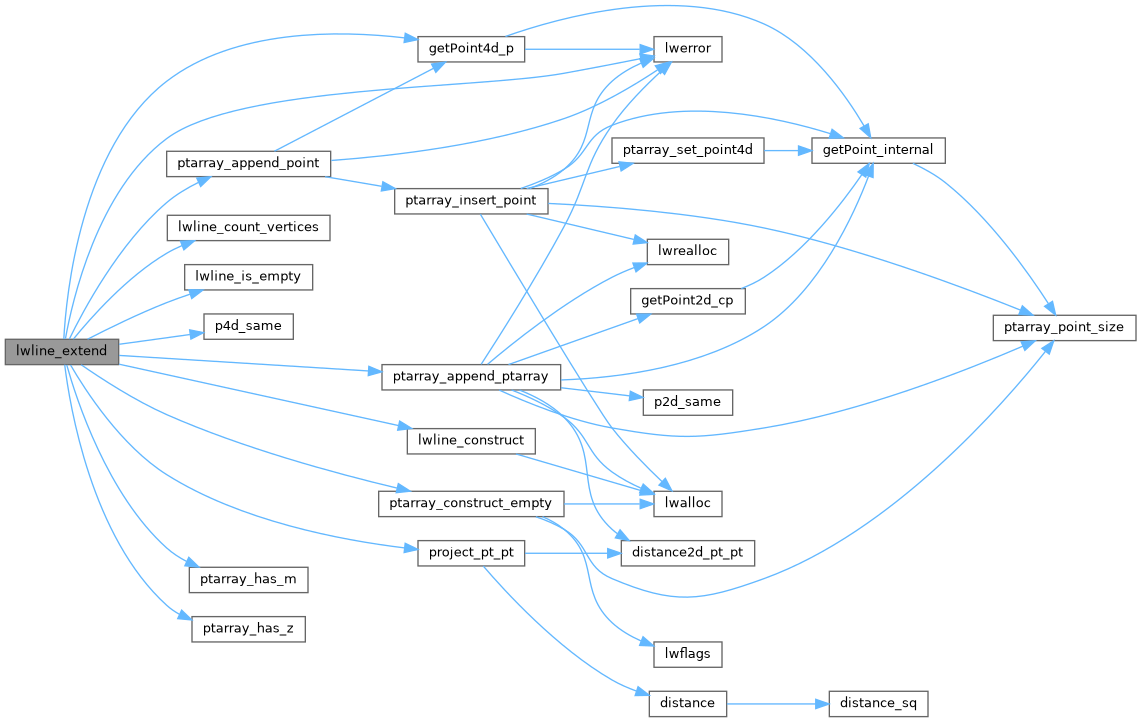
References getPoint4d_p(), lwerror(), lwline_construct(), lwline_count_vertices(), lwline_is_empty(), POINTARRAY::npoints, p4d_same(), LWLINE::points, project_pt_pt(), ptarray_append_point(), ptarray_append_ptarray(), ptarray_construct_empty(), ptarray_has_m(), ptarray_has_z(), and LWLINE::srid.
Referenced by geometry_line_extend().
Here is the call graph for this function:
Here is the caller graph for this function: