Loading...
Searching...
No Matches
◆ lwgeom_calculate_mbc()
| LWBOUNDINGCIRCLE * lwgeom_calculate_mbc | ( | const LWGEOM * | g | ) |
Definition at line 237 of file lwboundingcircle.c.
238{
239 SUPPORTING_POINTS* support;
241 LWPOINTITERATOR* it;
242 uint32_t num_points;
243 POINT2D** points;
244 POINT4D p;
245 uint32_t i;
246 int success;
247
250
251 num_points = lwgeom_count_vertices(g);
252 it = lwpointiterator_create(g);
254 for (i = 0; i < num_points; i++)
255 {
257 {
258 uint32_t j;
259 for (j = 0; j < i; j++)
260 {
261 lwfree(points[j]);
262 }
263 lwpointiterator_destroy(it);
264 lwfree(points);
266 }
267
271 }
272 lwpointiterator_destroy(it);
273
274 support = supporting_points_create();
276 /* Technically, a randomized algorithm would demand that we shuffle the input points
277 * before we call calculate_mbc(). However, we make the (perhaps poor) assumption that
278 * the order we happen to find the points is as good as random, or close enough.
279 * */
281
282 for (i = 0; i < num_points; i++)
283 {
284 lwfree(points[i]);
285 }
286 lwfree(points);
287 supporting_points_destroy(support);
288
289 if (!success)
290 return NULL;
291
293}
LWPOINTITERATOR * lwpointiterator_create(const LWGEOM *g)
Create a new LWPOINTITERATOR over supplied LWGEOM*.
Definition lwiterator.c:243
int lwpointiterator_next(LWPOINTITERATOR *s, POINT4D *p)
Attempts to assign the next point in the iterator to p, and advances the iterator to the next point.
Definition lwiterator.c:210
void lwpointiterator_destroy(LWPOINTITERATOR *s)
Free all memory associated with the iterator.
Definition lwiterator.c:268
uint32_t lwgeom_count_vertices(const LWGEOM *geom)
Count the total number of vertices in any LWGEOM.
Definition lwgeom.c:1337
static void supporting_points_destroy(SUPPORTING_POINTS *s)
Definition lwboundingcircle.c:47
static int calculate_mbc(const POINT2D **points, uint32_t max_n, SUPPORTING_POINTS *support, LWBOUNDINGCIRCLE *mbc)
Definition lwboundingcircle.c:174
static SUPPORTING_POINTS * supporting_points_create()
Definition lwboundingcircle.c:36
static LWBOUNDINGCIRCLE * lwboundingcircle_create()
Definition lwboundingcircle.c:217
static int lwgeom_is_empty(const LWGEOM *geom)
Return true or false depending on whether a geometry is an "empty" geometry (no vertices members)
Definition lwinline.h:199
Definition liblwgeom.h:1845
Definition lwiterator.c:45
Definition liblwgeom.h:389
Definition liblwgeom.h:413
Definition lwboundingcircle.c:29
References calculate_mbc(), LW_FAILURE, lwalloc(), lwboundingcircle_create(), lwfree(), lwgeom_count_vertices(), lwgeom_is_empty(), lwpointiterator_create(), lwpointiterator_destroy(), lwpointiterator_next(), result, supporting_points_create(), supporting_points_destroy(), POINT2D::x, POINT4D::x, POINT2D::y, and POINT4D::y.
Referenced by mbc_test(), ST_MinimumBoundingCircle(), ST_MinimumBoundingRadius(), and test_empty().
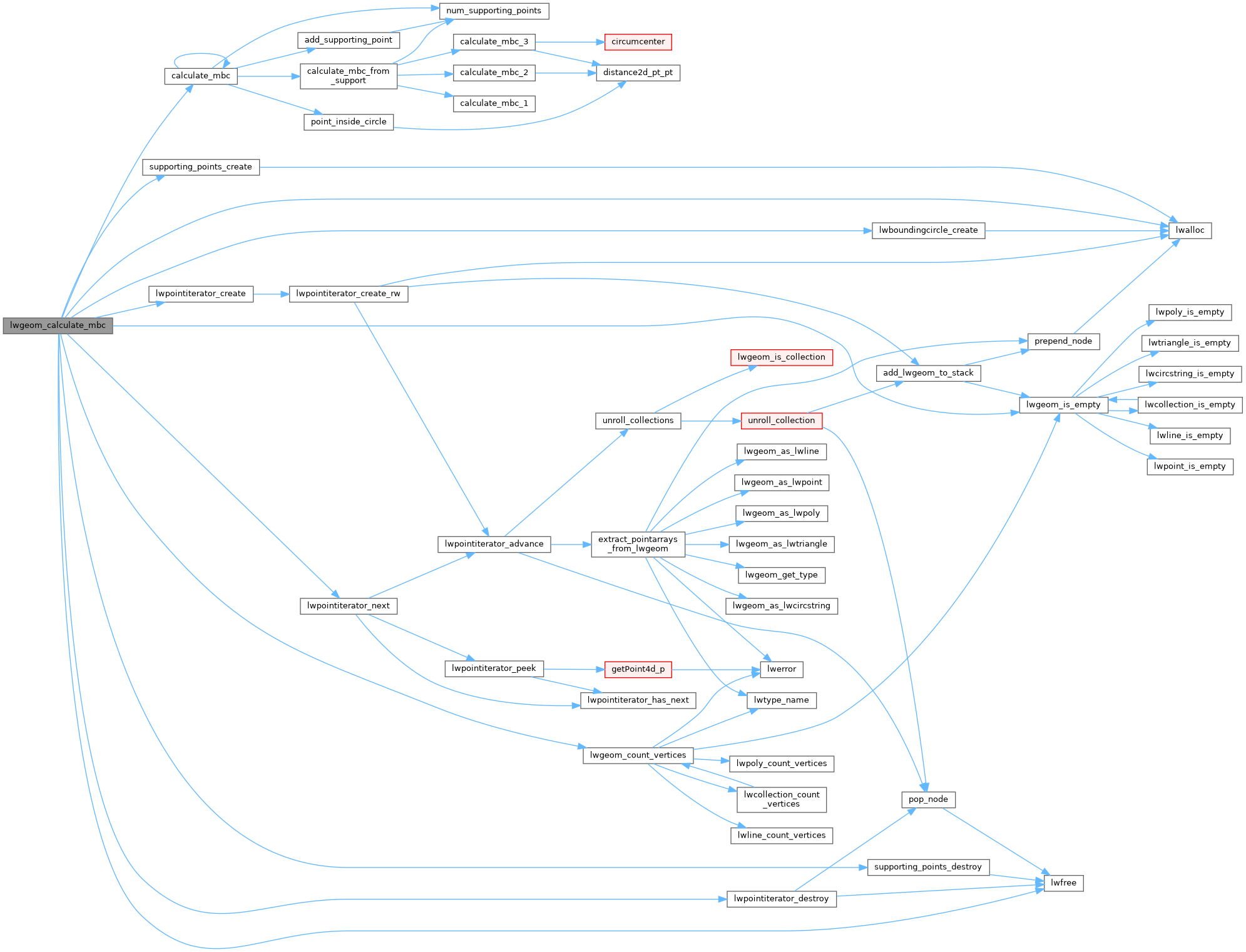
Here is the call graph for this function:
Here is the caller graph for this function: