Loading...
Searching...
No Matches
◆ ST_SwapOrdinates()
| Datum ST_SwapOrdinates | ( | PG_FUNCTION_ARGS | ) |
Definition at line 3078 of file lwgeom_functions_basic.c.
3079{
3080 GSERIALIZED *in;
3081 GSERIALIZED *out;
3082 LWGEOM *lwgeom;
3083 const char *ospec;
3084 LWORD o1, o2;
3085
3086 ospec = PG_GETARG_CSTRING(1);
3087 if (strlen(ospec) != 2)
3088 {
3089 lwpgerror(
3090 "Invalid ordinate specification. "
3091 "Need two letters from the set (x,y,z,m). "
3092 "Got '%s'",
3093 ospec);
3094 PG_RETURN_NULL();
3095 }
3096 o1 = ordname2ordval(ospec[0]);
3097 o2 = ordname2ordval(ospec[1]);
3098
3099 in = PG_GETARG_GSERIALIZED_P_COPY(0);
3100
3101 /* Check presence of given ordinates */
3103 {
3104 lwpgerror("Geometry does not have an M ordinate");
3105 PG_RETURN_NULL();
3106 }
3108 {
3109 lwpgerror("Geometry does not have a Z ordinate");
3110 PG_RETURN_NULL();
3111 }
3112
3113 /* Nothing to do if swapping the same ordinate, pity for the copy... */
3114 if (o1 == o2)
3115 PG_RETURN_POINTER(in);
3116
3117 lwgeom = lwgeom_from_gserialized(in);
3118 lwgeom_swap_ordinates(lwgeom, o1, o2);
3119 out = geometry_serialize(lwgeom);
3120 lwgeom_free(lwgeom);
3121 PG_FREE_IF_COPY(in, 0);
3122 PG_RETURN_POINTER(out);
3123}
LWGEOM * lwgeom_from_gserialized(const GSERIALIZED *g)
Allocate a new LWGEOM from a GSERIALIZED.
Definition gserialized.c:268
int gserialized_has_m(const GSERIALIZED *g)
Check if a GSERIALIZED has an M ordinate.
Definition gserialized.c:214
int gserialized_has_z(const GSERIALIZED *g)
Check if a GSERIALIZED has a Z ordinate.
Definition gserialized.c:203
void lwgeom_swap_ordinates(LWGEOM *in, LWORD o1, LWORD o2)
Swap ordinate values in every vertex of the geometry.
Definition lwgeom.c:1569
Definition liblwgeom.h:443
Definition liblwgeom.h:457
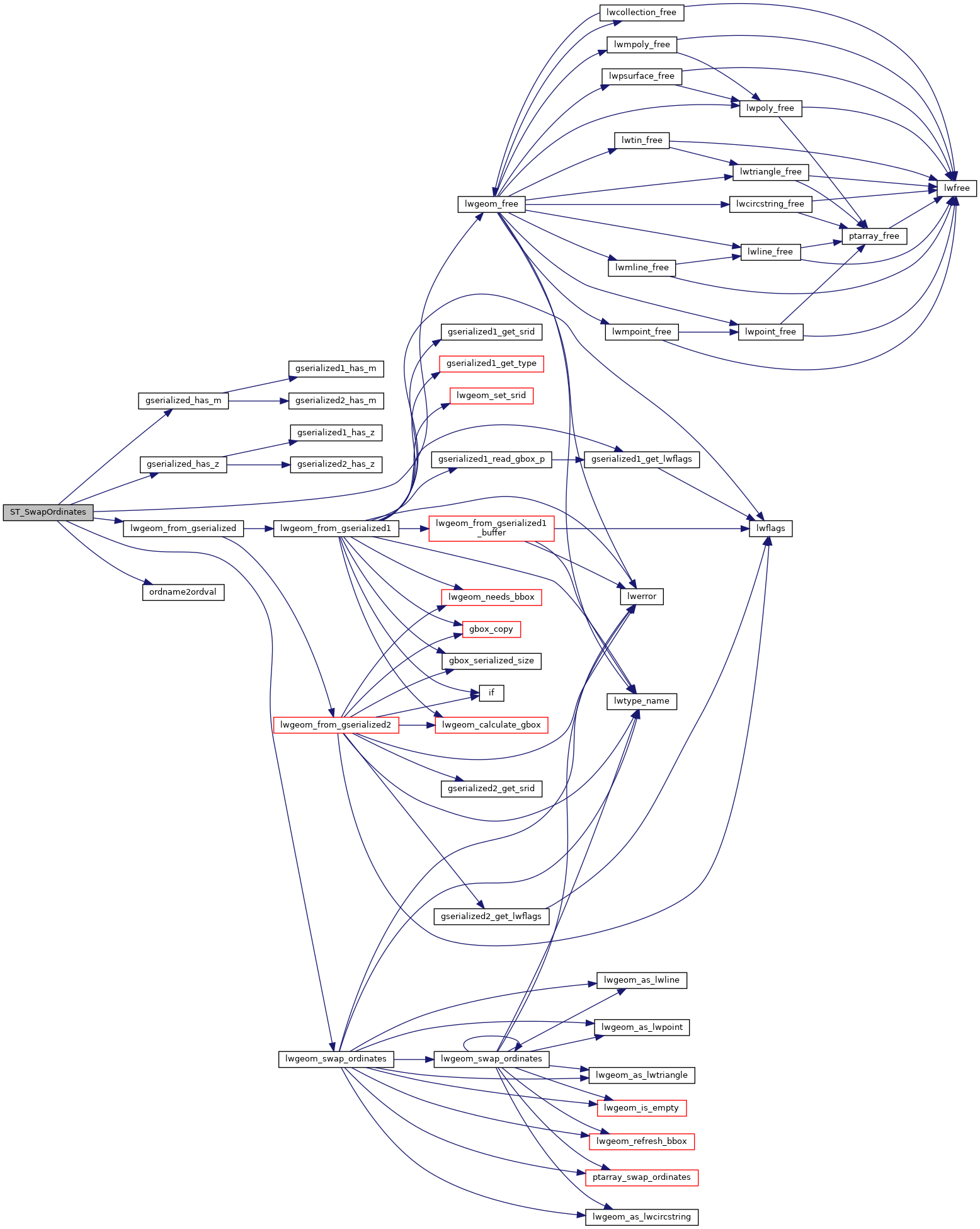
References gserialized_has_m(), gserialized_has_z(), lwgeom_free(), lwgeom_from_gserialized(), lwgeom_swap_ordinates(), LWORD_M, LWORD_Z, and ordname2ordval().
Here is the call graph for this function: