Loading...
Searching...
No Matches
◆ iterate_4d()
|
static |
Calculate denom to get the next point
Definition at line 48 of file lwgeom_median.c.
49{
50 uint32_t i, iter;
51 double delta;
52 double sum_curr = 0, sum_next = 0;
55
56 sum_curr = calc_weighted_distances_3d(curr, points, npoints, distances);
57
58 for (iter = 0; iter < max_iter; iter++)
59 {
60 POINT3D next = { 0, 0, 0 };
61 double denom = 0;
62
64 for (i = 0; i < npoints; i++)
65 {
66 /* we need to use lower epsilon than in FP_IS_ZERO in the loop for calculation to converge */
67 if (distances[i] > DBL_EPSILON)
68 {
72 denom += 1.0 / distances[i];
73 }
74 else
75 {
76 hit = LW_TRUE;
77 }
78 }
79
80 if (denom < DBL_EPSILON)
81 {
82 /* No movement - Final point */
83 break;
84 }
85
86 /* Calculate the new point */
87 next.x /= denom;
88 next.y /= denom;
89 next.z /= denom;
90
91 /* If any of the intermediate points in the calculation is found in the
92 * set of input points, the standard Weiszfeld method gets stuck with a
93 * divide-by-zero.
94 *
95 * To get ourselves out of the hole, we follow an alternate procedure to
96 * get the next iteration, as described in:
97 *
98 * Vardi, Y. and Zhang, C. (2011) "A modified Weiszfeld algorithm for the
99 * Fermat-Weber location problem." Math. Program., Ser. A 90: 559-566.
100 * DOI 10.1007/s101070100222
101 *
102 * Available online at the time of this writing at
103 * http://www.stat.rutgers.edu/home/cunhui/papers/43.pdf
104 */
105 if (hit)
106 {
107 double dx = 0, dy = 0, dz = 0;
108 double d_sqr;
109 hit = LW_FALSE;
110
111 for (i = 0; i < npoints; i++)
112 {
113 if (distances[i] > DBL_EPSILON)
114 {
118 }
119 }
120
121 d_sqr = sqrt(dx*dx + dy*dy + dz*dz);
122 if (d_sqr > DBL_EPSILON)
123 {
128 }
129 }
130
131 /* Check movement with next point */
132 sum_next = calc_weighted_distances_3d(&next, points, npoints, distances);
133 delta = sum_curr - sum_next;
134 if (delta < tol)
135 {
136 break;
137 }
138 else
139 {
143 sum_curr = sum_next;
144 }
145 }
146
147 lwfree(distances);
148 return iter;
149}
static double calc_weighted_distances_3d(const POINT3D *curr, const POINT4D *points, uint32_t npoints, double *distances)
Definition lwgeom_median.c:33
Definition liblwgeom.h:401
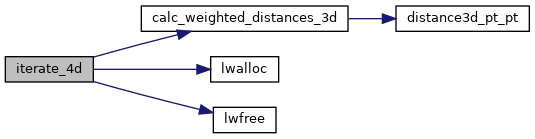
References calc_weighted_distances_3d(), FP_MAX, LW_FALSE, LW_TRUE, lwalloc(), lwfree(), POINT3D::x, POINT4D::x, POINT3D::y, POINT4D::y, POINT3D::z, and POINT4D::z.
Referenced by lwmpoint_median().
Here is the call graph for this function:
Here is the caller graph for this function: