Loading...
Searching...
No Matches
◆ rt_band_new_offline()
| rt_band rt_band_new_offline | ( | uint16_t | width, |
| uint16_t | height, | ||
| rt_pixtype | pixtype, | ||
| uint32_t | hasnodata, | ||
| double | nodataval, | ||
| uint8_t | bandNum, | ||
| const char * | path | ||
| ) |
Create an out-db rt_band.
- Parameters
-
width : number of pixel columns height : number of pixel rows pixtype : pixel type for the band hasnodata : indicates if the band has nodata value nodataval : the nodata value, will be appropriately truncated to fit the pixtype size. bandNum : 0-based band number in the external file to associate this band with. path : NULL-terminated path string pointing to the file containing band data. The string will NOT be copied, ownership is left to caller which is responsible to keep it allocated for the whole lifetime of the returned rt_band.
- Returns
- an rt_band, or 0 on failure
Definition at line 275 of file rt_band.c.
280 {
282 int pathlen = 0;
283
284 assert(NULL != path);
285
287 if (band == NULL) {
289 return NULL;
290 }
291
293 band, rt_pixtype_name(pixtype)
294 );
295
296 band->pixtype = pixtype;
297 band->offline = 1;
298 band->width = width;
299 band->height = height;
300 band->hasnodata = hasnodata ? 1 : 0;
301 band->nodataval = 0;
303 band->ownsdata = 0; /* offline, flag is useless as all offline data cache is owned internally */
304 band->raster = NULL;
305
306 /* properly set nodataval as it may need to be constrained to the data type */
309 rt_band_destroy(band);
310 return NULL;
311 }
312
313 band->data.offline.bandNum = bandNum;
314
315 /* memory for data.offline.path is managed internally */
316 pathlen = strlen(path);
320 rt_band_destroy(band);
321 return NULL;
322 }
323 memcpy(band->data.offline.path, path, pathlen);
325
326 band->data.offline.mem = NULL;
327
329}
void rterror(const char *fmt,...) __attribute__((format(printf
Wrappers used for reporting errors and info.
rt_errorstate rt_band_set_nodata(rt_band band, double val, int *converted)
Set nodata value.
Definition rt_band.c:884
Definition librtcore.h:2503
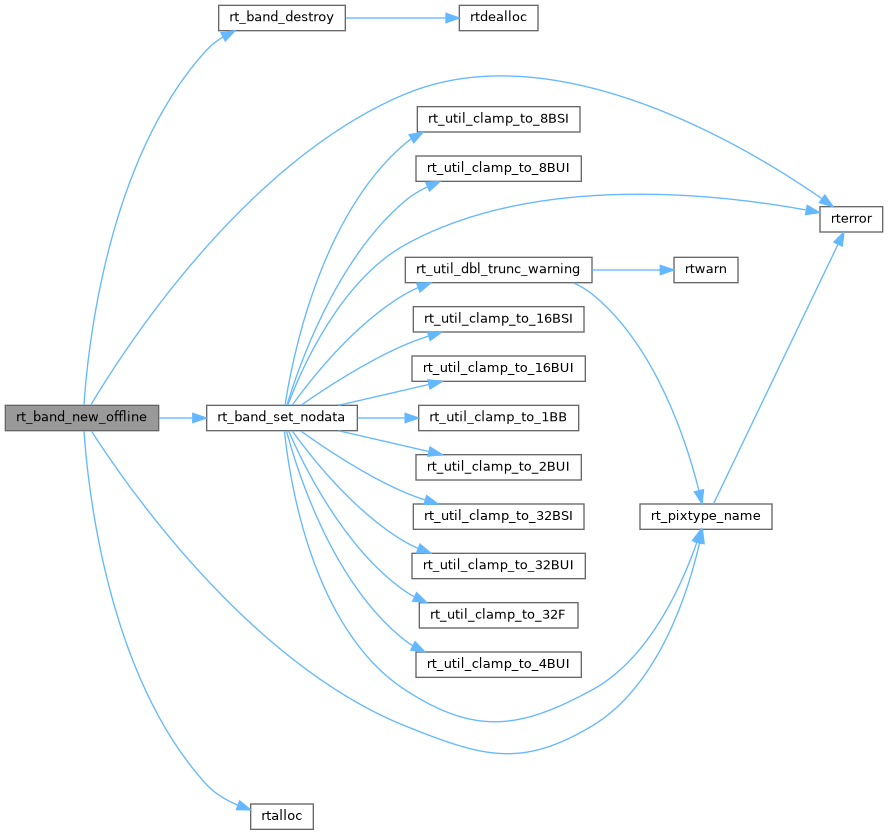
References ES_NONE, FALSE, RASTER_DEBUGF, rt_band_destroy(), rt_band_set_nodata(), rt_pixtype_name(), rtalloc(), and rterror().
Referenced by convert_raster(), RASTER_tile(), rt_band_duplicate(), rt_band_new_offline_from_path(), and test_band_metadata().
Here is the call graph for this function:
Here is the caller graph for this function: