Loading...
Searching...
No Matches
◆ lwgeom_voronoi_diagram()
| LWGEOM * lwgeom_voronoi_diagram | ( | const LWGEOM * | g, |
| const GBOX * | env, | ||
| double | tolerance, | ||
| int | output_edges | ||
| ) |
Take vertices of a geometry and build the Voronoi diagram.
- Parameters
-
g the input geometry env an optional envelope for clipping the results tolerance an optional snapping tolerance for improved robustness output_edges if non-zero the result will be a MULTILINESTRING, otherwise it'll be a COLLECTION of polygons.
Definition at line 1891 of file liblwgeom/lwgeom_geos.c.
1892{
1893 uint32_t num_points = lwgeom_count_vertices(g);
1894 LWGEOM* lwgeom_result;
1896 int32_t srid = lwgeom_get_srid(g);
1897 GEOSCoordSequence* coords;
1898 GEOSGeometry* geos_geom;
1899 GEOSGeometry* geos_env = NULL;
1900 GEOSGeometry* geos_result;
1901
1902 if (num_points < 2)
1903 {
1906 }
1907
1909
1910 /* Instead of using the standard LWGEOM2GEOS transformer, we read the vertices of the LWGEOM directly and put
1911 * them into a single GEOS CoordinateSeq that can be used to define a LineString. This allows us to process
1912 * geometry types that may not be supported by GEOS, and reduces the memory requirements in cases of many
1913 * geometries with few points (such as LWMPOINT).*/
1914 coords = lwgeom_get_geos_coordseq_2d(g, num_points);
1915 if (!coords) return NULL;
1916
1917 geos_geom = GEOSGeom_createLineString(coords);
1918 if (!geos_geom)
1919 {
1920 GEOSCoordSeq_destroy(coords);
1921 return NULL;
1922 }
1923
1925
1926 geos_result = GEOSVoronoiDiagram(geos_geom, geos_env, tolerance, output_edges);
1927
1928 GEOSGeom_destroy(geos_geom);
1929 if (env) GEOSGeom_destroy(geos_env);
1930
1931 if (!geos_result)
1932 {
1934 return NULL;
1935 }
1936
1937 lwgeom_result = GEOS2LWGEOM(geos_result, is_3d);
1938 GEOSGeom_destroy(geos_result);
1939
1940 lwgeom_set_srid(lwgeom_result, srid);
1941
1942 return lwgeom_result;
1943}
char lwgeom_geos_errmsg[LWGEOM_GEOS_ERRMSG_MAXSIZE]
Definition liblwgeom/lwgeom_geos.c:40
LWGEOM * GEOS2LWGEOM(const GEOSGeometry *geom, uint8_t want3d)
Definition liblwgeom/lwgeom_geos.c:166
static GEOSCoordSequence * lwgeom_get_geos_coordseq_2d(const LWGEOM *g, uint32_t num_points)
Definition liblwgeom/lwgeom_geos.c:1851
void lwgeom_set_srid(LWGEOM *geom, int32_t srid)
Set the SRID on an LWGEOM For collections, only the parent gets an SRID, all the children get SRID_UN...
Definition lwgeom.c:1530
uint32_t lwgeom_count_vertices(const LWGEOM *geom)
Count the total number of vertices in any LWGEOM.
Definition lwgeom.c:1229
LWCOLLECTION * lwcollection_construct_empty(uint8_t type, int32_t srid, char hasz, char hasm)
Definition lwcollection.c:92
LWGEOM * lwcollection_as_lwgeom(const LWCOLLECTION *obj)
Definition lwgeom.c:291
Definition liblwgeom.h:559
Definition liblwgeom.h:443
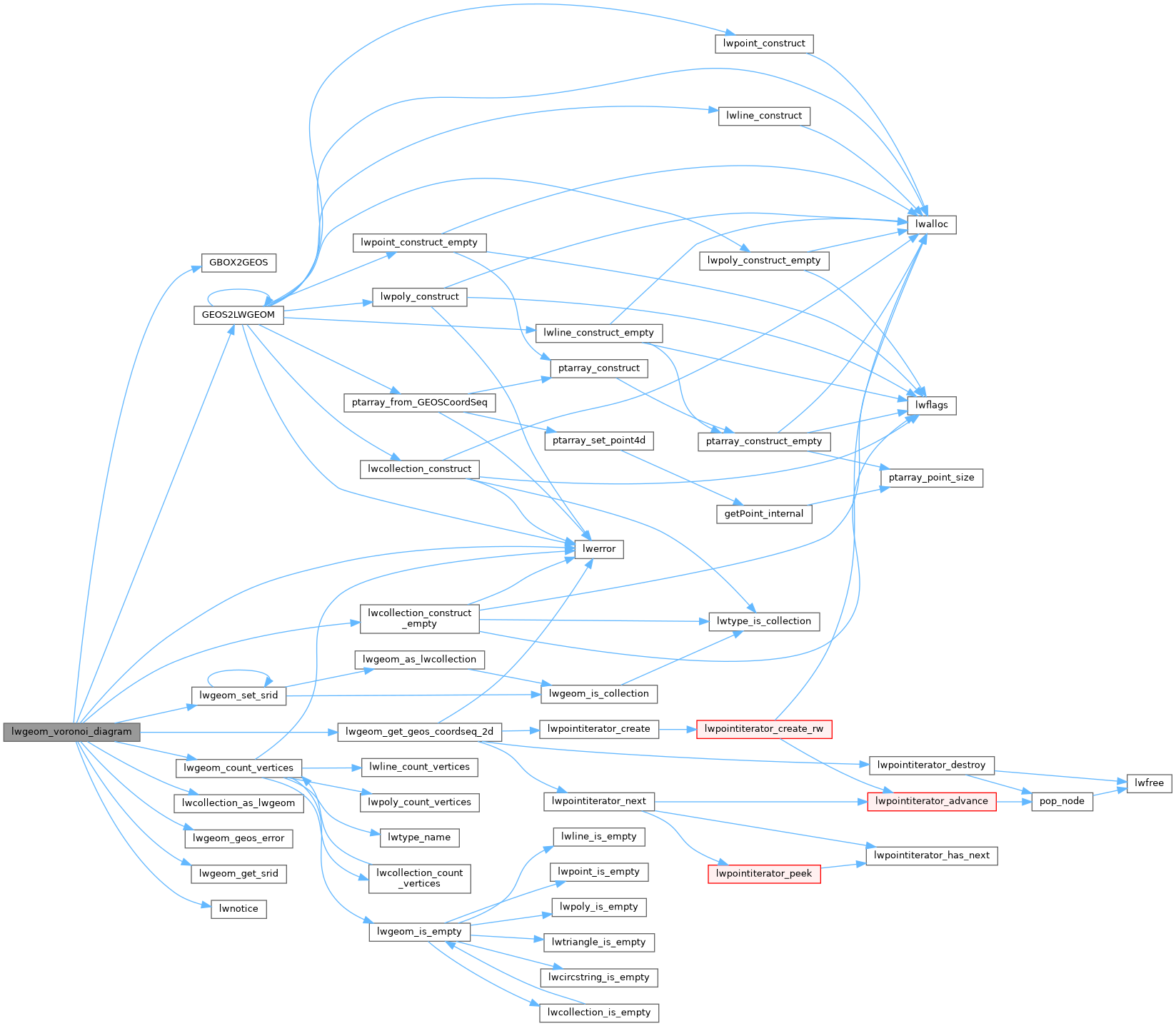
References COLLECTIONTYPE, GBOX2GEOS(), GEOS2LWGEOM(), LW_FALSE, lwcollection_as_lwgeom(), lwcollection_construct_empty(), lwerror(), lwgeom_count_vertices(), lwgeom_geos_errmsg, lwgeom_geos_error(), lwgeom_get_geos_coordseq_2d(), lwgeom_get_srid(), lwgeom_set_srid(), and lwnotice().
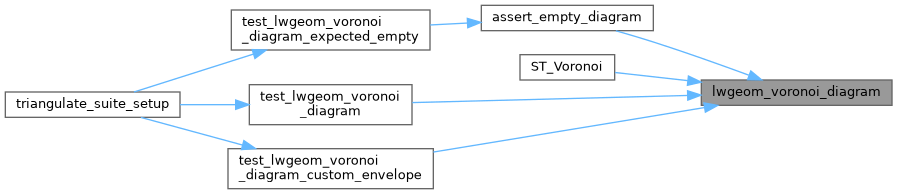
Referenced by assert_empty_diagram(), ST_Voronoi(), test_lwgeom_voronoi_diagram(), and test_lwgeom_voronoi_diagram_custom_envelope().
Here is the call graph for this function:
Here is the caller graph for this function: