Loading...
Searching...
No Matches
◆ lwcompound_linearize()
|
static |
Definition at line 572 of file lwstroke.c.
575{
576 LWGEOM *geom;
577 POINTARRAY *ptarray = NULL;
578 LWLINE *tmp = NULL;
579 uint32_t i, j;
580 POINT4D p;
581
583
584 ptarray = ptarray_construct_empty(FLAGS_GET_Z(icompound->flags), FLAGS_GET_M(icompound->flags), 64);
585
587 {
588 geom = icompound->geoms[i];
590 {
593 {
596 }
597 lwline_free(tmp);
598 }
600 {
601 tmp = (LWLINE *)geom;
603 {
606 }
607 }
608 else
609 {
611 return NULL;
612 }
613 }
614
615 ptarray_remove_repeated_points_in_place(ptarray, 0.0, 2);
617}
const char * lwtype_name(uint8_t type)
Return the type name string associated with a type number (e.g.
Definition lwutil.c:216
POINTARRAY * ptarray_construct_empty(char hasz, char hasm, uint32_t maxpoints)
Create a new POINTARRAY with no points.
Definition ptarray.c:59
LWLINE * lwline_construct(int32_t srid, GBOX *bbox, POINTARRAY *points)
Definition lwline.c:42
int getPoint4d_p(const POINTARRAY *pa, uint32_t n, POINT4D *point)
Definition lwgeom_api.c:125
int ptarray_append_point(POINTARRAY *pa, const POINT4D *pt, int allow_duplicates)
Append a point to the end of an existing POINTARRAY If allow_duplicate is LW_FALSE,...
Definition ptarray.c:147
void ptarray_remove_repeated_points_in_place(POINTARRAY *pa, double tolerance, uint32_t min_points)
Definition ptarray.c:1460
static LWLINE * lwcircstring_linearize(const LWCIRCSTRING *icurve, double tol, LW_LINEARIZE_TOLERANCE_TYPE tolerance_type, int flags)
Definition lwstroke.c:512
Definition liblwgeom.h:491
Definition liblwgeom.h:443
Definition liblwgeom.h:467
Definition liblwgeom.h:399
Definition liblwgeom.h:412
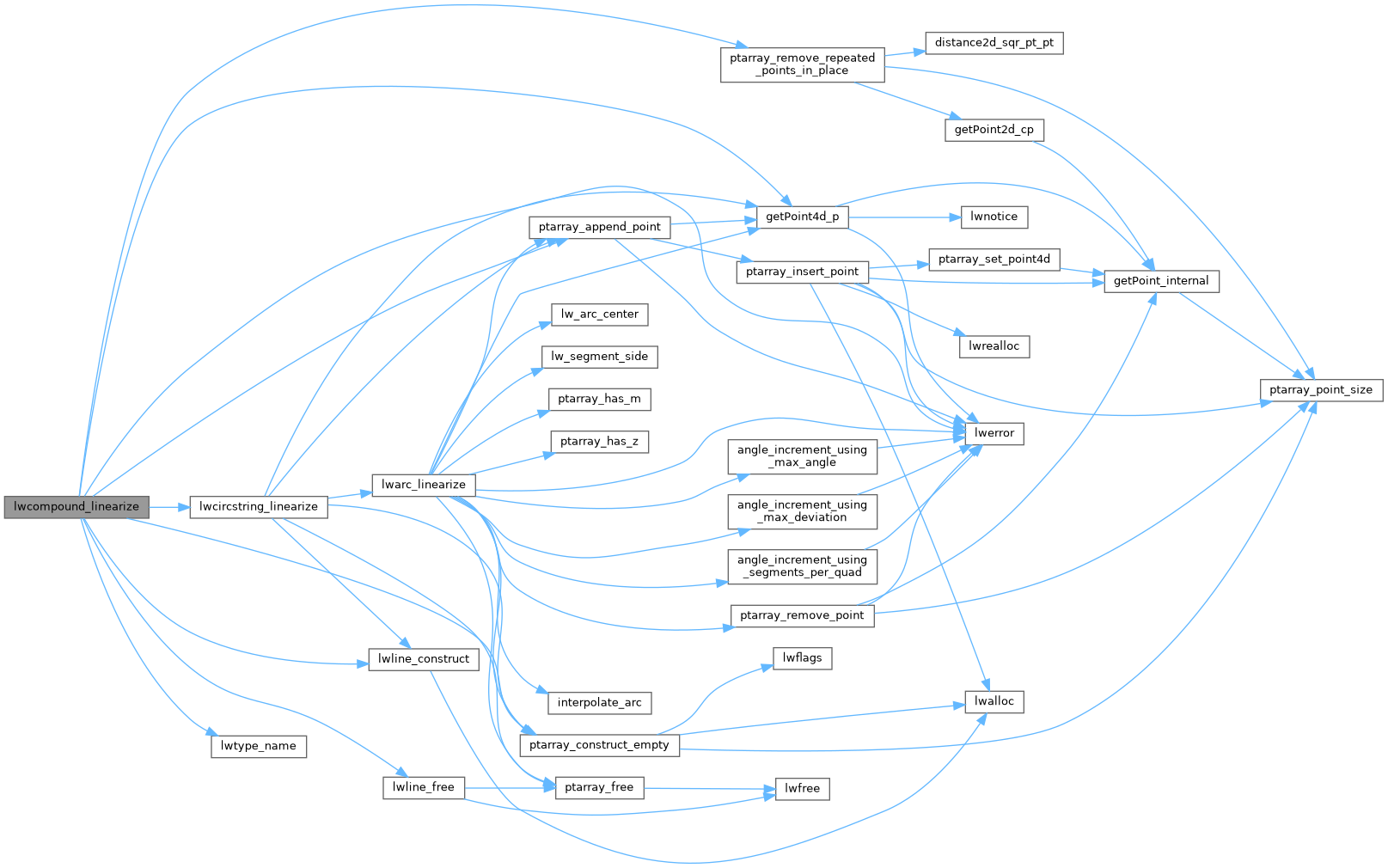
References CIRCSTRINGTYPE, LWCOMPOUND::flags, FLAGS_GET_M, FLAGS_GET_Z, LWCOMPOUND::geoms, getPoint4d_p(), LINETYPE, LW_TRUE, lwcircstring_linearize(), LWDEBUG, lwerror(), lwline_construct(), lwline_free(), lwtype_name(), LWCOMPOUND::ngeoms, POINTARRAY::npoints, LWLINE::points, ptarray_append_point(), ptarray_construct_empty(), ptarray_remove_repeated_points_in_place(), LWCOMPOUND::srid, and LWGEOM::type.
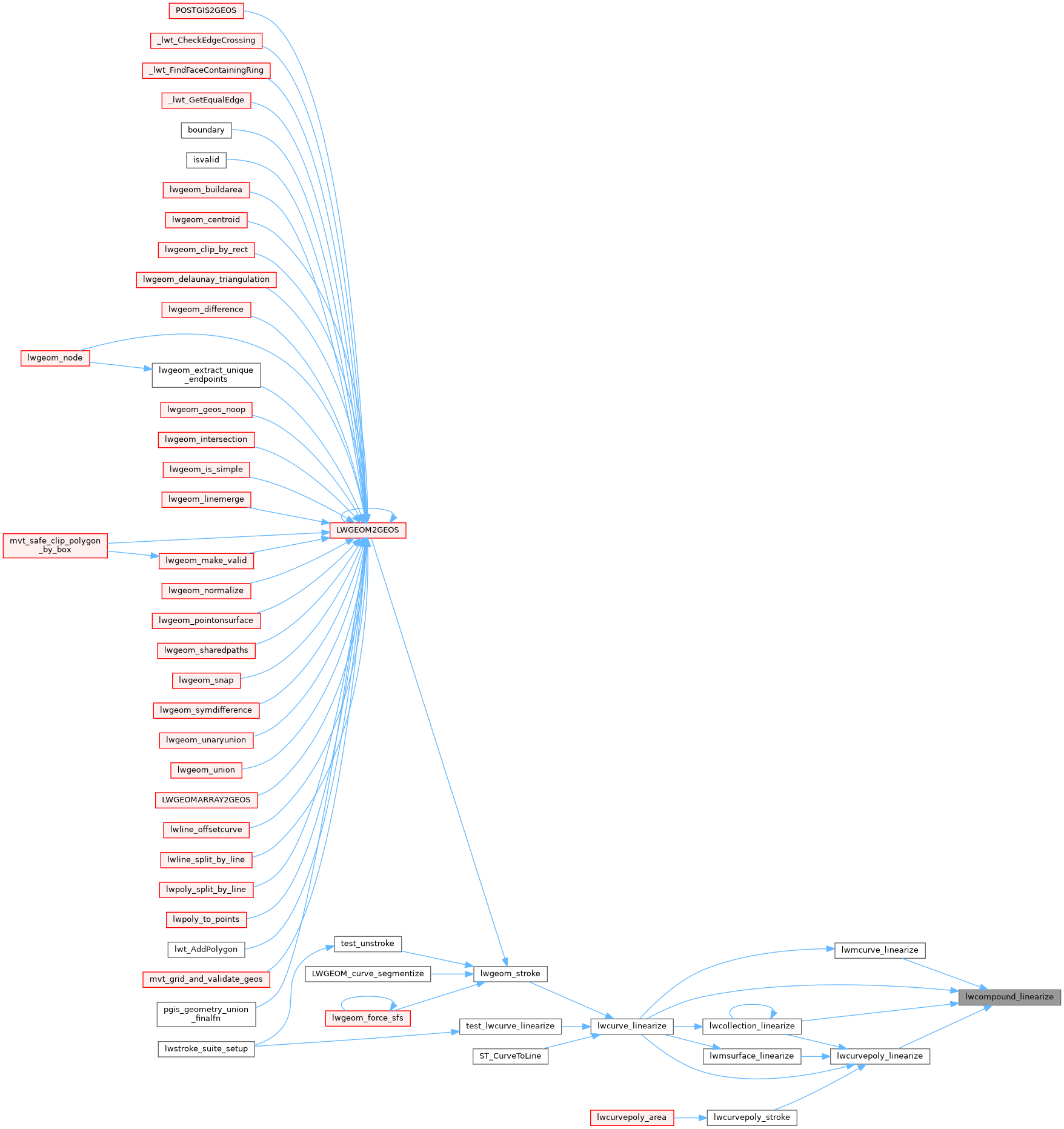
Referenced by lwcollection_linearize(), lwcurve_linearize(), lwcurvepoly_linearize(), and lwmcurve_linearize().
Here is the call graph for this function:
Here is the caller graph for this function: